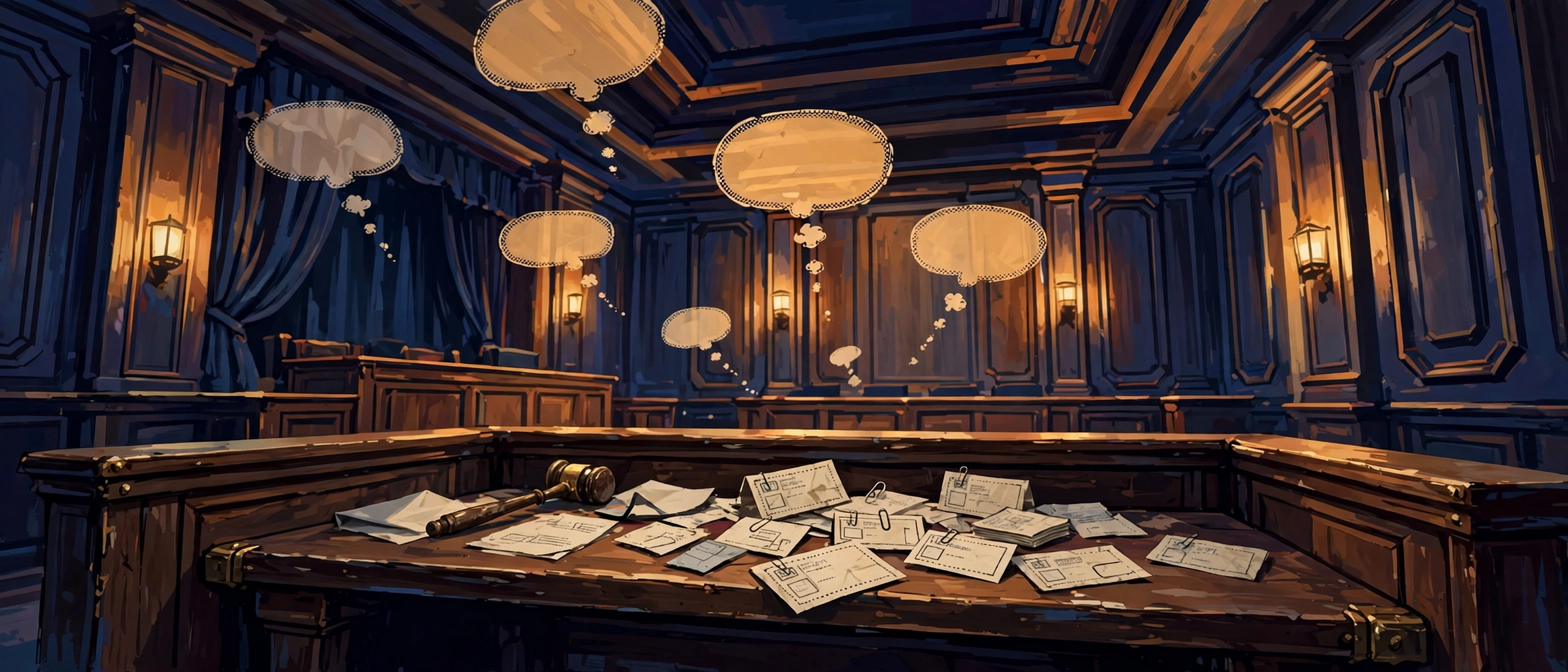
A rookie defense attorney, a client nobody believes, and a witness whose story falls apart the moment you compare it with the object in your hand. Gyakuten Saiban — released overseas years later as Phoenix Wright: Ace Attorney — turned the courtroom into a puzzle box in 2001, on a handheld, with no action at all. This guide covers the original Game Boy Advance version: its four episodes, the two-phase investigation/trial structure, the press-and-present grammar of cross-examination, and the five-penalty system that decides how bold you can afford to be.
Quick facts
| Item | Details |
|---|---|
| Original title | 逆転裁判 (Gyakuten Saiban) |
| English title | Phoenix Wright: Ace Attorney |
| Platform | Game Boy Advance |
| Release (Japan) | October 12, 2001 |
| Developer / Publisher | Capcom Production Studio 4 / Capcom |
| Creator / Director | Shu Takumi |
| Genre | Courtroom adventure (visual novel) |
| Episodes in this version | 4 (a fifth episode was added later, in the Nintendo DS version — see the version note below) |
Overview
You play Ryuichi Naruhodo (Phoenix Wright), a defense attorney on his very first case, working under his mentor Chihiro Ayasato (Mia Fey) and later alongside her younger sister Mayoi (Maya Fey), a spirit medium in training. The game's world runs on an "initial trial" system adopted to clear a backlog of cases: a trial lasts at most three days, and the judge rules at the end of it. There is no jury to persuade — only testimony, evidence, and the gaps between them.
The first episode is trial only. From the second episode onward, each case moves back and forth between two phases. In the investigation phase you visit the crime scene, the detention center and related locations, gathering evidence and statements with four commands. In the trial phase you face a prosecutor — in most of this game, the prodigy Reiji Mitsurugi (Miles Edgeworth) — and cross-examine witnesses. Testimony arrives as a series of statements. You may press any statement to push the witness for more detail, or present a piece of evidence from the Court Record against a statement to expose a contradiction. Find the contradiction and the story moves; present the wrong thing and the judge penalizes you.
That is the entire game, and it is enough. The tension comes from a simple fact: the evidence list is always in front of you, the testimony is always in front of you, and the lie is always in the overlap. The game never asks for reflexes — it asks whether you were paying attention three conversations ago.
Why it still matters
Gyakuten Saiban was a Japan-only GBA release in 2001; the series only reached the West in 2005, when the Nintendo DS remake added an English version. What looks today like an established genre template — investigation scenes feeding courtroom logic puzzles — was this game's invention, designed by Shu Takumi to be simple enough, in his oft-repeated phrase, for his mother to play. Its mechanics became the series grammar for decades: pressing, presenting, the Court Record, the shouted "Objection!" (Igiari!).
The GBA original is also the purest form of the design. Later entries add Psyche-Locks (from the second game), a health-style penalty meter, and forensic mini-games. Here there is none of that: five exclamation marks, four episodes, and contradictions. If you want to understand why the formula works, this is the version where nothing distracts from it.
Highlights
- Cross-examination as the whole battle system. Every "boss fight" is a witness. Pressing is almost always free; presenting is the attack, and it costs you if you miss. The one exception to free pressing is in Episode 4 (see the penalty table below).
- A penalty system with a hard number. The first game gives you five mistakes (shown as exclamation marks). Lose all five and your client is declared guilty — game over. Later games replaced this with a meter; the GBA original's fixed count makes every present a weighed decision.
- Episodes that escalate in structure. A one-day tutorial trial grows into multi-day cases with investigations between court days, new witnesses mid-trial, and testimony that gets revised as you break it.
- The fourth episode's layered case. Turnabout Goodbyes puts prosecutor Edgeworth himself in the defendant's chair, against his legendary mentor Go Karuma (Manfred von Karma), and ties the trial to the 15-year-old DL-6 Incident — the emotional core of the whole series starts here.
Strategy essentials
1. The four episodes of the GBA original
| # | Episode | Defendant | Prosecutor | Structure | What it teaches |
|---|---|---|---|---|---|
| 1 | The First Turnabout | Larry Butz (Masashi Yahari) | Winston Payne | Trial only, 1 day | The basics: press everything, present the one object that cannot fit the testimony. Short enough to restart without pain if you burn penalties learning |
| 2 | Turnabout Sisters | Maya Fey (Mayoi Ayasato) | Miles Edgeworth (Reiji Mitsurugi) | Investigation + 2 trial days | The full loop for the first time: gather evidence between court days, and expect broken testimony to be revised and re-examined |
| 3 | Turnabout Samurai | Will Powers | Miles Edgeworth | 3 investigation sessions + 3 trial sessions | Timetables and movement: who could physically be where, and when. Photos and schedules in the Court Record do the heavy lifting |
| 4 | Turnabout Goodbyes | Miles Edgeworth | Manfred von Karma (Go Karuma) | 3 investigation sessions + 3 trial sessions | Everything at once, against a prosecutor who objects to your objections. A case inside the case: the present trial and a 15-year-old incident explain each other |
Version note. The fifth episode, Rise from the Ashes, does not exist in this GBA version. It was written for the 2005 Nintendo DS remake to use that hardware's features. Any guide that walks you through a fifth case, Psyche-Locks, or a penalty meter is describing a later version, not this one.
2. Press or present — the decision table
| Situation | Do this | Why |
|---|---|---|
| First time through any testimony | Press every statement, in order — with one Episode 4 exception noted below | Pressing almost never costs a penalty, and it frequently adds new statements, changes wording, or unlocks the line the contradiction actually hangs on. The exception is Lotta Hart's short added testimony in Episode 4 ("I saw it clear as day..."): pressing that statement itself incurs a penalty, so present the evidence there instead |
| A statement mentions a time, place, number or object you have evidence about | Compare it with the Court Record entry before presenting | Most contradictions in this game are factual mismatches — a stated time against a recorded time, a described object against the real one |
| You pressed and the testimony changed | Re-read the whole testimony from the top | The new version, not the old one, is what the next contradiction is keyed to. Presenting against a removed statement wastes the attempt |
| You are fairly sure, but not certain | Save first (the game lets you save during trials), then present | A wrong present costs one of only five penalties. Saving before a risky present is the standard veteran habit in this version |
| You have pressed everything and see nothing | Re-examine the evidence descriptions, not just the names | Several solutions hide in an item's detailed description — a second fact recorded on the same object |
3. Managing the five penalties
| Rule | Detail |
|---|---|
| Penalty stock | 5 exclamation marks, shown during trial phases |
| Cost of a wrong present | 1 mark per penalty — in this first game a penalty always removes a single mark, unlike the variable amounts in later games |
| Cost of pressing | None in almost every case — press freely and often — but not quite always: pressing Lotta Hart's added statement in Episode 4 incurs a penalty, so present there instead of pressing |
| At zero marks | The judge declares your client guilty on the spot: game over, reload a save |
| Recovery | Marks are replenished at the end of each act (each trial or investigation segment); there is no in-trial healing item in this version |
| Separate from penalties | A few scripted choices can end the case at once regardless of remaining marks — for example, in Episode 4, letting Lotta Hart's cross-examination close without demanding her photo enlargement leads straight to a guilty verdict |
| Practical budget | Episodes 2–4 have long cross-examinations. Entering the final cross-examination of a case with 2 or fewer marks is the real danger zone — that is where multi-step contradictions chain together |
4. Investigation habits that pay off in court
| Habit | Payoff |
|---|---|
| Examine every highlighted spot, even obvious ones | Evidence picked up in investigation is the ammunition for trial. The next trial does not begin until the required evidence and information have been gathered, so a required item cannot simply be left behind and make a later contradiction unprovable. If progress stalls, revisit the locations, conversations and evidence presents to find what has not been done yet |
| Talk through every topic with every character | Topics unlock other topics, and witnesses mention times and places that later become the contradiction |
| Present evidence to people during investigation | Characters react to specific items; some reactions are optional flavor, others hand you the item or fact the trial will need |
| Check the Court Record after each segment | New evidence quietly joins old evidence. Knowing your full inventory is most of the game's difficulty |
Who it's for
Players who like deduction as a verb: reading carefully, holding two statements in mind, and enjoying the moment a story collapses. It suits mystery and visual-novel readers completely, and it remains one of the most approachable adventure games ever made — no fail states outside the courtroom, no dexterity anywhere. Players who want the later series' extra systems (Psyche-Locks, forensic tools) should start with a later version instead; players who want the design in its cleanest form should start here.
How to play it today
The original GBA cartridge was a Japanese-only release and circulates on the second-hand market. The game itself is widely available today through its many official ports and the Ace Attorney Trilogy collection on modern platforms — those versions are based on the later DS-era releases, so they include the fifth episode and the revised penalty presentation, while the four original episodes play as described above.
Find original hardware editions on eBay
As an eBay Partner Network affiliate, Enkeisha may earn a commission from qualifying purchases made through these links.
Search eBay listings (affiliate link)
Check the language, region, hardware compatibility, condition and authenticity before buying. Search results may include reproductions; links do not endorse individual sellers.