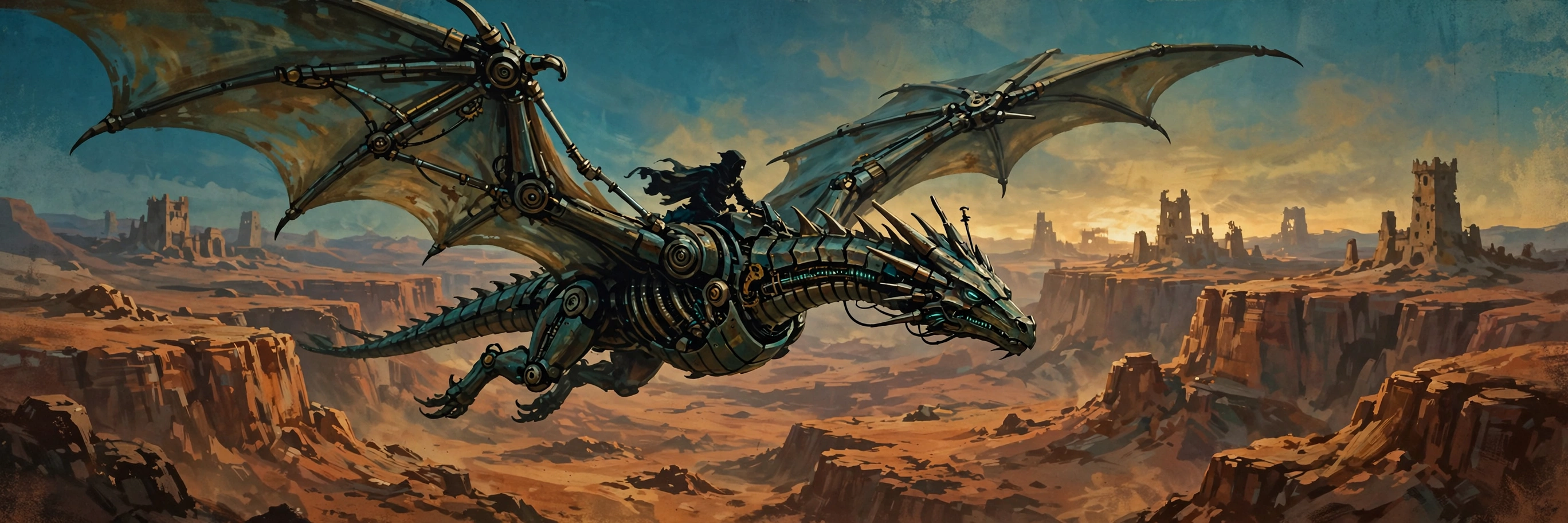
Two rail shooters became, almost without warning, one of the most original role-playing games of the 32-bit era. Azel: Panzer Dragoon RPG — released in the West as Panzer Dragoon Saga — keeps the dragon and the lock-on lasers, but rebuilds everything around them: free-roaming flight, towns explored on foot, and a battle system where three slowly filling gauges and your position around the enemy matter more than any menu of spells. This guide covers the Saturn original across its four discs: how the gauge economy works, when to use the dragon's lasers and when to use Edge's gun, and how the five dragon classes reshape every fight.
Quick facts
| Item | Details |
|---|---|
| Original title | AZEL -パンツァードラグーン RPG- (Azel: Panzer Dragoon RPG) |
| English title | Panzer Dragoon Saga |
| Platform | Sega Saturn |
| Release (Japan) | January 29, 1998 (Western releases followed in spring 1998) |
| Developer / Publisher | Team Andromeda / Sega |
| Genre | Role-playing (aerial combat, free exploration) |
| Media | 4 CDs |
Overview
You are Edge, a young mercenary guarding an Imperial excavation site. When the rogue officer Craymen attacks the site, Edge is the only survivor — rescued by a dragon that chooses him as its rider. At the site Edge glimpsed a girl sealed in ancient ruins: Azel, a bio-engineered being of the vanished Ancient Age, built to interface with its technology. Empires, rebels and the dragon itself all have designs on her, and the story that follows is told with full voice acting and real-time 3D throughout — an extravagant production for the Saturn, spread over four discs.
Play divides into three modes. On the dragon you cross open 3D environments — valleys, seas, ruins — with random encounters. On foot you explore towns, camps and dungeons in third person, talking, shopping and solving the route forward. And once, memorably, the dragon is swapped for a hoverbike. Battles are the heart of it, and they inherit the shooters' DNA: you do not face the enemy from a fixed line, you circle it.
In battle, both sides act on three action gauges that fill in real time. One full gauge buys one basic action. The dragon's lock-on laser — one gauge — paints multiple targets and is your area damage. Edge's gun — also one gauge — fires at a single point and is how you snipe weak points, which the laser cannot prioritize. Berserk attacks, the game's magic, generally need two or more gauges and also consume a separate resource, BP (Berserk Points). Around the enemy runs a radar ring of four quadrants, colored by danger: green is safe, uncolored is neutral, red is where the enemy's attacks hit hardest — and often where its weak point faces you. Moving between quadrants is free of gauge cost but takes time, during which the enemy's gauges keep filling.
Why it still matters
Saga was one of the last major Saturn releases and sold in small numbers in the West; it has never been officially re-released, and it is routinely listed among the greatest RPGs of its generation anyway. The reason is that its systems were never really copied. The gauge-and-quadrant battle model makes positioning, timing and form — not equipment menus — the core RPG decisions, and the dragon-morphing system (below) turns character building into something you do during a fight, reversibly, at the cost of one gauge.
It is also a landmark of presentation: a fully 3D, fully voiced RPG on hardware famous for struggling with 3D, carrying an invented language for its world and a story that trusts ambiguity. The four-disc scale is real, but the game is notably focused — a main quest measured in tens of hours rather than a hundred, with almost no filler.
Highlights
- Position is a resource. The safest quadrant and the quadrant facing the weak point are rarely the same one. Every fight is a small negotiation between damage taken and damage dealt.
- A dragon you re-spec mid-battle. Once morphing unlocks, shifting between Attack, Defense, Agility and Spiritual emphasis costs one gauge and can be done in combat — changing lasers, bulk, gauge speed and Berserk behavior on the fly.
- Berserks are learned by form. The dragon learns Berserk techniques with a priority toward its current class, so how you fight decides what it becomes.
- The Ancient Age stays strange. Ruins, bio-engineered life and a dragon with its own agenda — the game explains less than most RPGs, and is better for it.
Strategy essentials
1. The gauge economy
| Gauges spent | Actions available | Notes |
|---|---|---|
| 1 | Dragon's lock-on laser; Edge's gun; use an item; morph the dragon | Laser and gun are both 1-gauge actions — choose by target shape, not by power alone |
| 2 | Most Berserk attacks (also cost BP) | Waiting for a second gauge means the enemy also acts sooner. Berserks are strong, but a laser volley now often beats a Berserk late |
| 3 | Full-gauge class abilities (no BP cost); the strongest Berserks | Class abilities (table 3) are the reward for banking all three gauges — and while all three are full, your class grants a passive bonus |
| 0 (movement) | Change quadrant | Free of gauge cost, but real time passes and enemy gauges charge. Move with a purpose: to a green quadrant, or to face a weak point |
Gauge charge speed is governed by the dragon's Agility. That single fact drives much of the build logic: Agility is not just evasion, it is actions per minute.
2. Laser or gun?
| Lock-on laser | Edge's gun | |
|---|---|---|
| Cost | 1 gauge | 1 gauge |
| Targets | Multiple lock-ons, spread across the enemy's parts | Normally one target; attachments such as Tri-Burst alter this. |
| Best against | Groups, enemies with several breakable parts, general damage | A single exposed weak point; finishing a specific part |
| Scales with | Dragon's Attack attribute / class | Gun upgrades found and bought through the game (including multi-way fire) |
| Watch out for | Cannot choose which part matters most | The standard shot favors a specific part. Check the equipped attachment and target count when choosing. |
A practical rhythm for hard fights: use the gun while a weak point is exposed and you are in its quadrant; use lasers for everything else; spend the turns in dangerous quadrants quickly, and do your waiting (for gauges 2–3) in green ones.
3. The five dragon classes
Morphing is unlocked when the dragon attains its Valiant Wing form in the story. Shifting the balance of the four attributes (Attack / Defense / Agility / Spiritual) sets the dragon's class — raising one attribute lowers its opposite. Each class has a full-gauge ability (3 gauges, no BP) and a passive while all gauges are full.
| Class | Emphasis / trade-off | Full-gauge ability (3 gauges, no BP) | Passive while all 3 gauges are full | Level-up tendency |
|---|---|---|---|---|
| Normal | Attributes balanced; no bonus, no penalty | Healing Wing — restores a large amount of HP | Slowly regenerates HP | Even growth; learns Berserks across all classes |
| Attack | Lasers stronger and more numerous; Spiritual falls, so Berserks weaken and cost more BP | Assault Wing — further raises laser power until the battle ends | Occasionally fires a lock-on volley for free | Laser power grows; Attack-class Berserks prioritized |
| Defense | Takes less damage; Agility falls, so movement and gauge speed suffer | Protection Wing — further reduces damage taken until the battle ends | Defense raised further | HP grows faster; Defense-class Berserks prioritized |
| Spiritual | Berserks stronger and cheaper in BP; laser power falls | Berserker Wing — restores a sizable amount of BP | Slowly regenerates BP | BP grows faster; Spiritual-class Berserks prioritized |
| Agility | Moves faster between quadrants and gauges charge faster; takes more damage when hit | Swift Wing — further speeds gauge charging | Abnormal status effects on the dragon are cleared | Edge's gun power grows faster; Agility-class Berserks prioritized |
Hybrids exist between neighboring emphases, but the dragon belongs to one class at a time. Two working patterns cover most hard fights: Agility to bank gauges in safety, then Spiritual to spend them on a Berserk; or Attack to fire, then Defense to ride out the counterattack. A morph costs one gauge — budget it like any other action.
4. Habits that carry the four discs
| Habit | Why it matters |
|---|---|
| Check the radar before every action, not after | Quadrant colors change as enemies turn and as parts break. The red quadrant you entered for a weak point may stay red after the point is gone |
| Keep BP items stocked | BP does not refill by resting your way out of every problem; Berserk Micros/Minors are the difference between a Berserk build and a stranded one |
| Break parts deliberately | Many enemies have parts that disable specific attacks when destroyed. The gun exists for this — one disabled attack can recolor the whole radar |
| Morph outside battle for the area, inside battle for the boss | Area travel favors Agility (faster gauges, faster fights); bosses reward deliberate class switching |
| Save at every opportunity on later discs | The fourth disc is weighted toward the endgame sequence; long stretches between saves are the real difficulty spike |
Who it's for
Players who want an RPG whose battles cannot be played on autopilot, and who value a strange, melancholic world over a long checklist of side content. It is also essential for Saturn collectors and for anyone tracing where later "positioning + gauge" battle systems came from. Players who need modern conveniences or dislike random encounters should be aware of its older design: many modern conveniences are absent, while random encounters remain. The design is very much of 1998, in its strengths and its frictions alike.
How to play it today
Azel / Panzer Dragoon Saga has never received an official re-release or remake (the 2020 Panzer Dragoon: Remake covers the first rail shooter, not this RPG), so the legitimate route remains the original Sega Saturn discs and hardware. The Japanese version is the most attainable of the originals on the second-hand market; Western versions are famously scarce.
Note: The header image is an original illustration; no game screens, sprites, logos or other extracted assets are used.
Find original hardware editions on eBay
As an eBay Partner Network affiliate, Enkeisha may earn a commission from qualifying purchases made through these links.
Search eBay listings (affiliate link)
Check the language, region, hardware compatibility, condition and authenticity before buying. Search results may include reproductions; links do not endorse individual sellers.