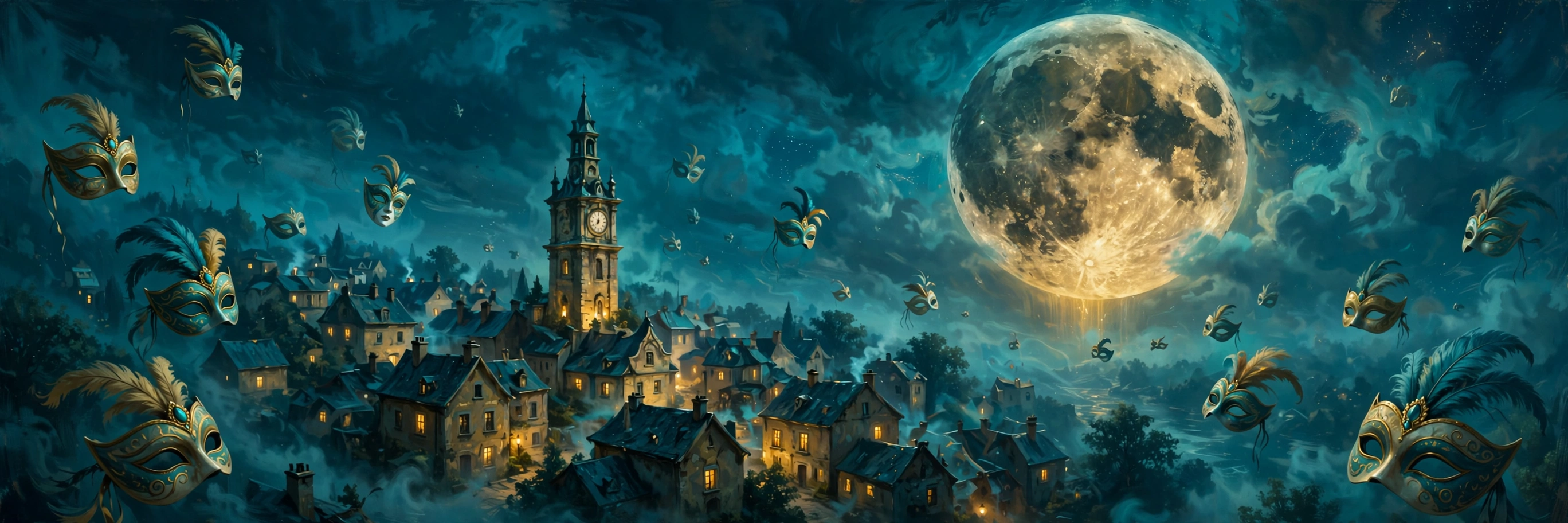
The moon falls in three days, and it falls forever until you stop it. Majora's Mask takes the engine of Ocarina of Time and rebuilds it around a single ruthless idea: a 72-hour clock that resets, townspeople who live by timetables, and 24 masks that turn preparation itself into the game. This is a deep strategy guide to the Japanese Nintendo 64 original — how to manage the cycle, what each transformation actually does, the order the four dungeons want to be played in, and where first-time players lose hours to the clock. Details such as the save system also follow the Japanese N64 version.
Quick facts
| Item | Detail |
|---|---|
| Original title | ゼルダの伝説 ムジュラの仮面 (Zeruda no Densetsu: Mujura no Kamen) |
| English title | The Legend of Zelda: Majora's Mask |
| Platform | Nintendo 64 |
| Release date (Japan) | April 27, 2000 |
| Developer / Publisher | Nintendo EAD / Nintendo |
| Directors | Eiji Aonuma, Yoshiaki Koizumi |
| Music | Koji Kondo, Toru Minegishi |
| Genre | Action-adventure (three-day time cycle, mask transformations) |
| Note | The original release requires the Expansion Pak |
Overview
Link follows the Skull Kid into Termina, a parallel land centred on Clock Town, and is cursed into the body of a Deku Scrub. The Happy Mask Salesman gives him three days to recover the Ocarina of Time and Majora's Mask. He succeeds at the first part — and that is where the real game begins, because the moon is still falling, and the only way forward is to play the Song of Time and live the same three days again, better prepared each time.
The structure is a hub and four directions. Clock Town sits in the middle of Termina Field. To the south lies the Southern Swamp and Woodfall Temple; to the north, Snowhead and its temple inside a mountain of ice; to the west, Great Bay and its temple under the sea; to the east, Ikana Canyon and the inverted Stone Tower Temple. Each region follows the same rhythm: a people in trouble, a song learned, a dungeon cleared, a Giant freed. Free all four Giants, call them at the top of the Clock Tower on the Final Day, and the moon can be stopped.
What makes it unlike any other Zelda is what persists. Playing the Song of Time returns you to the dawn of the First Day. Dungeon keys, rupees in hand, arrows, bombs and other consumables are lost; masks, major items, songs, Heart Containers and banked rupees are kept. Knowledge is the real currency: every cycle, you know more of the town's timetable than the last.
Why It Still Matters
Majora's Mask was built quickly on Ocarina of Time's technology, and the constraint produced the series' boldest design. Because the world repeats every 72 in-game hours (about 54 minutes of real time at normal speed), Nintendo could afford to give nearly every named character in Clock Town a schedule, a problem and a three-day arc — something no static world of the era could match. The Bomber's Notebook, added to log those people and their events, is effectively a quest journal years before that became standard.
It is also the series' darkest mainline entry in tone: a story about grief, failed guardians and a town going through the five stages of denial under a falling moon. Modern players usually meet it through the 2015 Nintendo 3DS remake, which softens several systems; the Japanese N64 original remains the sharper, stricter version — the Japanese N64 version saves with the Song of Time and has no temporary save at owl statues. Owl statues are a means of warping to a statue you have activated. This should be distinguished from the temporary-save system of the overseas N64 version and of the GC version and others based on it. That strictness is exactly what makes its timetable world feel alive.
Highlights
- A world run by timetables. The postman counts his steps, the inn fills and empties, couples meet or fail to meet — all on a fixed three-day schedule you can learn, exploit and eventually repair.
- Transformation as moveset, not costume. The Deku, Goron and Zora masks are complete alternate characters with their own movement, combat and instruments.
- Stone Tower Temple. A dungeon you clear, then flip upside down and clear again — still one of the most admired dungeon concepts in the series.
- Side quests with endings. The Anju and Kafei quest chains across all three days and pays out in story as much as in masks; it is the benchmark the rest of the game is judged by.
Strategy Essentials
1. Managing the three days — the songs and rules that matter
| Tool | Effect | When to use it |
|---|---|---|
| Song of Time | Returns to dawn of Day 1; keeps permanent items, loses consumables and dungeon keys | At the end of a productive cycle, or immediately after banking rupees |
| Inverted Song of Time (play the Song of Time's notes in reverse order) | Slows the flow of time | Learn it from the Scarecrow in the Astral Observatory / Trading Post side; use it on any dungeon cycle — it is the single biggest difficulty lever in the game |
| Song of Double Time (each note of the Song of Time doubled) | Skips forward to the next dawn or dusk | For reaching timed events (inn scenes, deliveries) without waiting |
| Song of Soaring | Warps to activated owl statues | Activate every owl statue you pass. The Japanese N64 version saves with the Song of Time; owl statues are for warping and hold no temporary save. This should be distinguished from the temporary-save system of the overseas N64 version, the GC version and others |
| Clock Town bank | Deposited rupees survive a Song of Time reset (with a small fee on withdrawal in some versions of the routine) | Always deposit before resetting; a full wallet carried into a reset is simply deleted |
Cycle discipline. Never enter a dungeon without the Inverted Song of Time active and a full cycle ahead of you. Clear a region's pre-dungeon quest and its dungeon in the same cycle where possible; if the clock will not allow it, finish the quest, note the warp point the dungeon gives you, reset, and use the shortcut that every cleared pre-quest leaves behind (a warp directly to the dungeon entrance) on the next cycle.
2. The 24 masks — transformations first, then the ones that gate progress
There are 24 masks in total. Four transform Link; the other 20 grant abilities, access or quest outcomes.
The full 24 are as follows. Transformations (4): Deku Mask, Goron Mask, Zora Mask, Fierce Deity's Mask. The others (20): Postman's Hat, All-Night Mask, Blast Mask, Stone Mask, Great Fairy's Mask, Keaton Mask, Bremen Mask, Bunny Hood, Don Gero's Mask, Mask of Scents, Romani's Mask, Circus Leader's Mask, Kafei's Mask, Couple's Mask, Mask of Truth, Kamaro's Mask, Gibdo Mask, Garo's Mask, Captain's Hat, Giant's Mask.
| Mask | Form / effect | Core abilities that matter |
|---|---|---|
| Deku Mask | Transformation — Deku Scrub | Spin attack while moving, hop across water surfaces a limited number of times, launch from Deku Flowers to glide; weak to fire |
| Goron Mask | Transformation — Goron | Ground pound, fast rolling that becomes spiked and magic-fuelled at full speed, punch combo; sinks in water, immune to lava floors |
| Zora Mask | Transformation — Zora | Fast, free swimming with a dolphin-style jump, twin fin boomerangs, electric barrier that drains magic; weak to fire and ice |
| Fierce Deity's Mask | Transformation — Fierce Deity | Adult-sized form with sword beams; usable only in boss rooms. Earned by trading all 20 non-transformation masks to the children on the Moon |
| Mask of Truth | Reads Gossip Stones and animals' thoughts | Several heart-piece and hint routes run through it |
| Bremen Mask | March that small animals follow | Needed for the animal-gathering reward chain at the ranch |
| Bunny Hood | Greatly increases running speed | Quality-of-life essential on every cycle; get it early from the Cucco Shack at Romani Ranch |
| Great Fairy's Mask | Attracts stray fairies in dungeons | Each temple's 15 stray fairies trade for a major upgrade (see Section 3 for the Japanese N64 version's rewards) — wear it inside dungeons |
| Blast Mask | A reusable explosion that damages Link without a shield guard | Bomb substitute from the start of the game; block with the shield to take no damage |
| Stone Mask | Makes Link unremarkable to most enemies | Ikana and the Pirate's Fortress become far simpler |
| Kamaro's Mask, Captain's Hat, Gibdo Mask, others | Quest and access keys disguised as masks | Most remaining masks resolve one specific person's timetable problem — the notebook tells you whose |
3. The four dungeons — order, boss and the one mechanic each teaches
| Order | Dungeon (region) | Key mechanic | Boss | Practical notes |
|---|---|---|---|---|
| 1 | Woodfall Temple (Southern Swamp) | Deku Flower flight, lighting the central torch to purify the poisoned water and rotate the flower-shaped platform, poisoned water outside | Odolwa | Learn the dungeon grammar here: stray fairies (15 per temple) are optional but, in the Japanese N64 version, Woodfall's 15 pay an enhanced Spin Attack upgrade from the Great Fairy |
| 2 | Snowhead Temple (Snowhead) | Goron rolling up ramps, a central pillar you pound down floor by floor | Goht | The pillar is the dungeon: lower it in stages to open the boss route. Rolling control is the real exam |
| 3 | Great Bay Temple (Great Bay) | Zora swimming, redirecting water currents through a rotating central system | Gyorg | Set the current's direction before chasing switches; the temple is a plumbing diagram, not a maze |
| 4 | Stone Tower Temple (Ikana Canyon) | Playing the Elegy of Emptiness to leave statues, flipping the entire temple with Light Arrows | Twinmold | Two dungeons in one shell: clear it, flip it, clear it again. Bring the Giant's Mask from the inverted side for the boss |
For reference: in the Japanese N64 version the Great Fairy rewards are Woodfall = enhanced Spin Attack, Snowhead = doubled Magic Meter, Great Bay = double defence, Stone Tower = the Great Fairy's Sword. In the 3DS version the Woodfall and Snowhead rewards are swapped, so do not conflate the two.
Before the end. With all four Giants freed, climb the Clock Tower after midnight on the Final Day and play the Oath to Order. If you want the Fierce Deity's Mask, complete the mask set first — the Moon's children trade their mini-dungeons for your 20 non-transformation masks, and the Fierce Deity's Mask is the reward for giving up all of them.
4. Heart Pieces and efficiency notes
Majora's Mask has no Heart Pieces hidden inside its main dungeons' critical path; growth comes from the town. Prioritise, in order: the Bunny Hood (speed is time, and time is the resource), the bank habit (never reset holding rupees), the Great Fairy's Mask before each temple's fairy hunt, and the Bomber's Notebook's timed events in the cycles between dungeons. Bottle count matters more than heart count for the boss rush at the end — bottles are obtained from events such as rescuing Koume and the beaver races at Great Bay, among others. The Pirate's Fortress is a place where you collect Zora Eggs using bottles you already have; it is not a place where you obtain an empty bottle.
Who It's For
For players who like learning a system more than clearing a map: Majora's Mask rewards observation, note-taking and rerouting a plan across loops. Zelda players who bounced off its clock usually find the Inverted Song of Time changes everything — with it, this is a dense, melancholy adventure rather than a race. Players who want a straightforward dungeon crawl in order will still find Ocarina of Time the easier recommendation.
How to Play It Today
The N64 original is playable today through official re-releases and collections, including Nintendo Switch Online + Expansion Pack and the 2015 Nintendo 3DS remake Majora's Mask 3D, which revises saving, the Bomber's Notebook and several boss fights — this guide describes the Japanese N64 original, which saves with the Song of Time and has no temporary save at owl statues. This differs from the temporary-save system of the overseas N64 version and of the GC version and others based on it, and from the save system of the 3DS remake. Original N64 cartridges (which require the Expansion Pak) also circulate on the second-hand market.
Find original hardware editions on eBay
As an eBay Partner Network affiliate, Enkeisha may earn a commission from qualifying purchases made through these links.
Search eBay listings (affiliate link)
Check the language, region, hardware compatibility, condition and authenticity before buying. Search results may include reproductions; links do not endorse individual sellers.