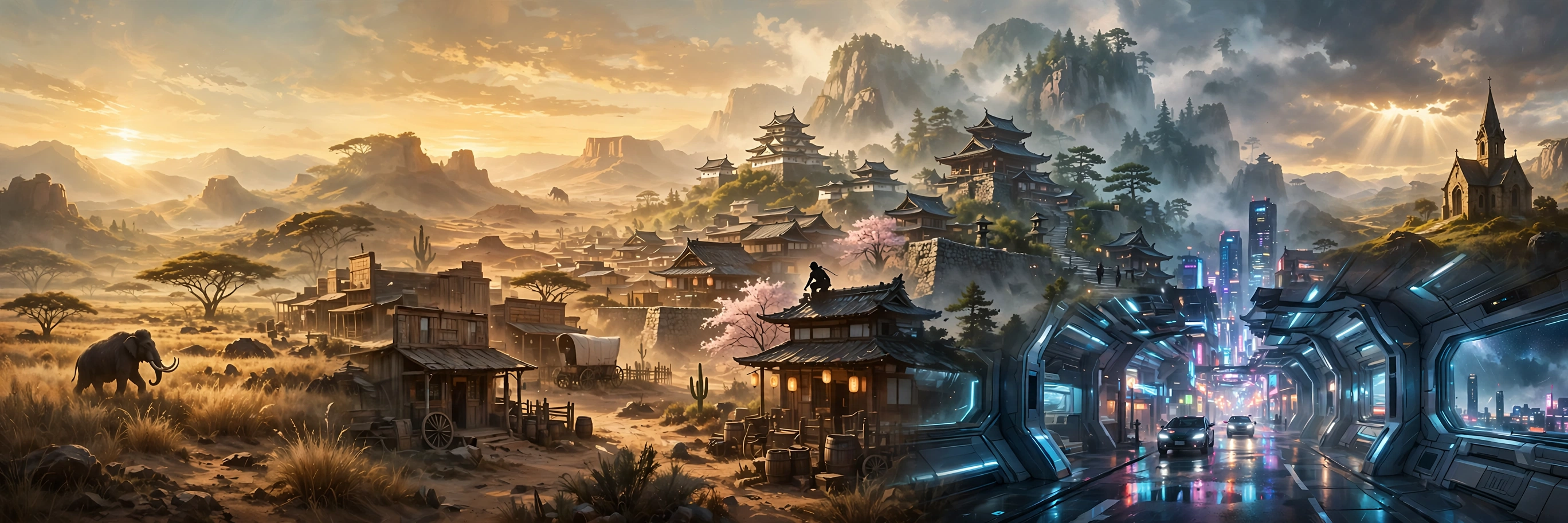
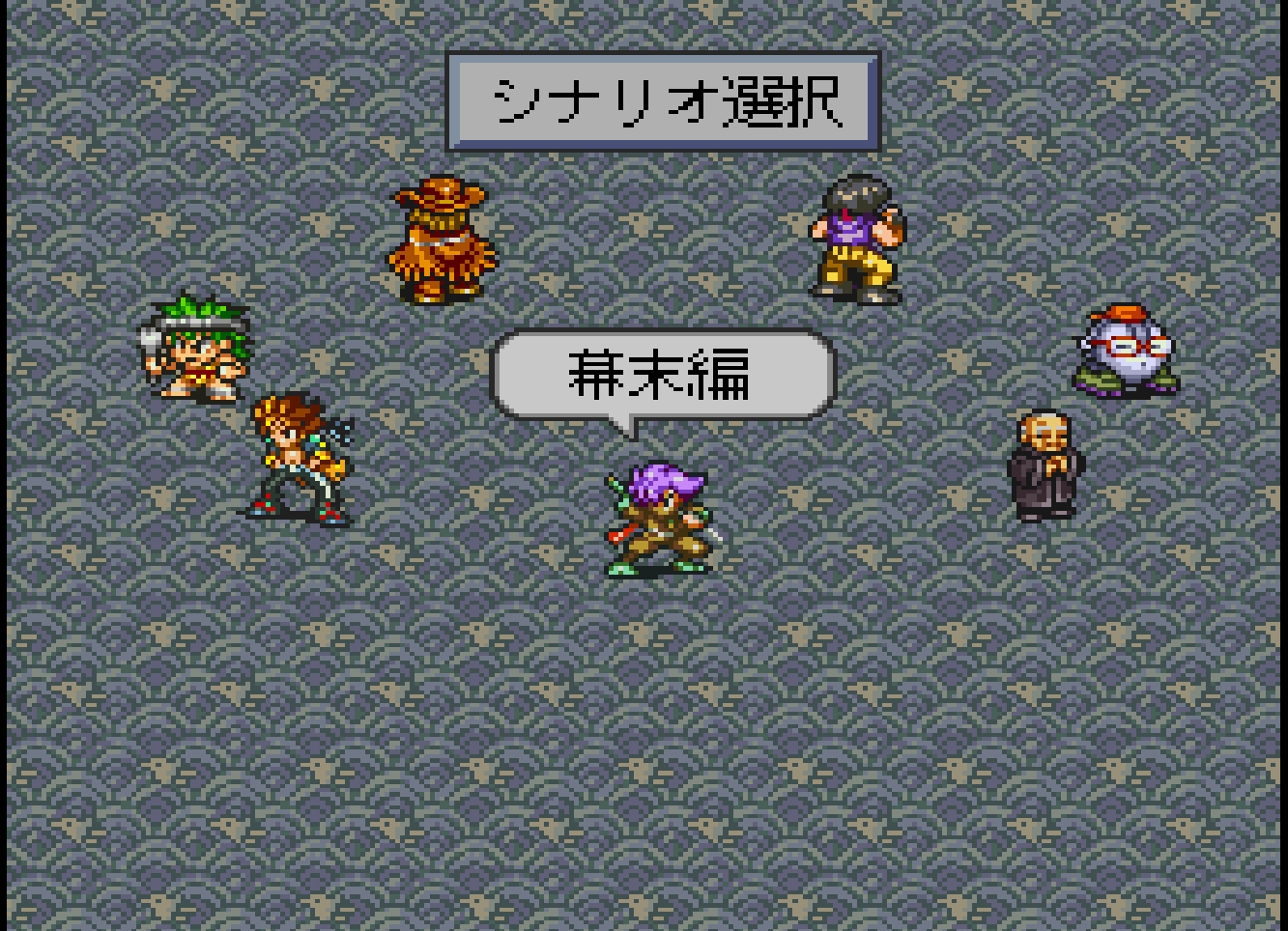
Most RPGs give you one world and one hero. Live A Live gives you seven of each — a caveman, a kung fu master, a ninja, a gunslinger, a street fighter, a psychic teenager and a maintenance robot — and lets you play their stories in any order, in a cartridge released for the Super Famicom in 1994. Then, when you think the anthology is over, it unlocks an eighth story that recontextualises everything, and a ninth that brings all seven heroes together.
It is also one of the great "what if" stories of the 16-bit era. Live A Live was never released outside Japan in its original form. For 28 years, Western players knew it through import cartridges and an unofficial fan translation, until the HD-2D remake of 2022 finally took it worldwide. This guide is about the original: how its nine scenarios fit together, how its grid-based battle system actually works, and the chapter-specific tricks — trained disciples, trap-setting, learned techniques, a shinobi kill counter — that decide whether you finish it.
Quick Facts
| Item | Detail |
|---|---|
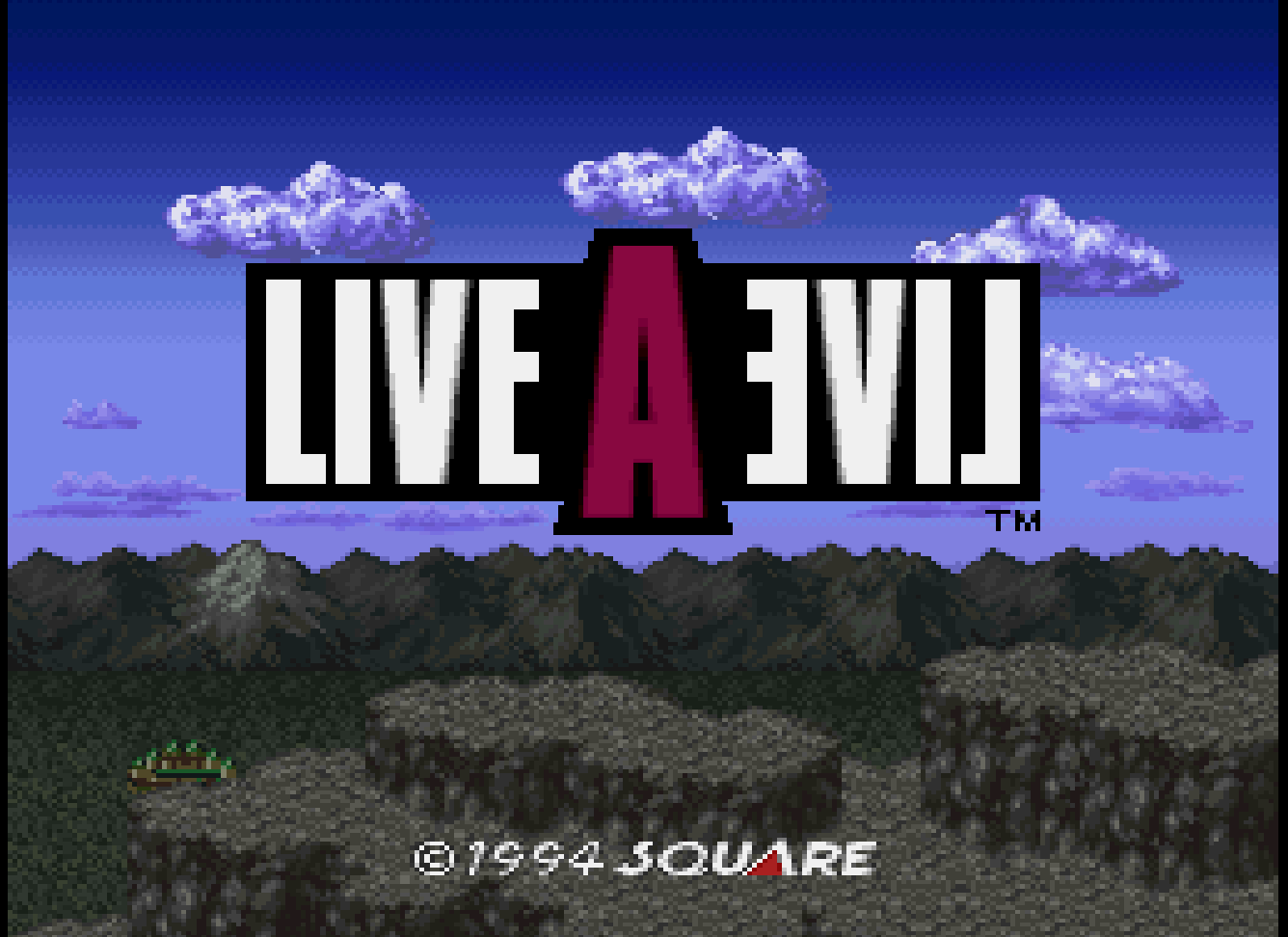
| Title | Live A Live (ライブ・ア・ライブ) |
| Platform | Super Famicom |
| Developer / Publisher | Square |
| Director | Takashi Tokita |
| Release (Japan) | September 2, 1994 |
| Genre | Role-playing game (omnibus structure; grid-based tactical battles) |
| Music | Yoko Shimomura |
| Character design | A different manga artist for each of the seven opening scenarios (see table below); additional design by Kiyofumi Katō (Square) |
| Cartridge | 16 Mbit (2 MB), battery-backed save |
| Structure | 7 opening scenarios in any order, then an unlockable Middle Ages chapter, then a Final Chapter |
| Original overseas release | None — Japan only on Super Famicom |
| Remake | HD-2D remake, first released July 22, 2022 (Nintendo Switch; other platforms followed in 2023) |
Overview
The game opens on a character select screen with seven portraits, and no instruction about where to start. Each scenario is a self-contained short RPG — most take roughly one to three hours — with its own protagonist, setting, supporting cast and rules. A prehistoric tale told without a single line of written dialogue. A kung fu succession drama. A stealth infiltration of a trap-filled castle. A western that builds toward a single gunfight. A fighting-game boss rush. A near-future adventure driven by telepathy. A science-fiction story aboard a cargo ship, with essentially no conventional battles at all.
Underneath the variety sits one shared battle system (detailed below) and one quiet thread: in every era, the hero's great enemy bears a name built on "Odio" — Odo, Ou Di Wan Lee, Ode Iou, O. Dio, Odie O'Bright, Odeo, OD-10. Finish all seven scenarios and the Middle Ages chapter unlocks: a deliberately conventional story of a knight, a princess and a Lord of Dark that is, in fact, the key to the whole game. Finish that, and the Final Chapter gathers the seven protagonists for an ending that the anthology has been setting up all along.
Progression differs by chapter, and that is part of the design. Some heroes gain levels and techniques in the usual way. Others barely level at all: the kung fu master's growth is spent on his disciples, Masaru grows only by learning his opponents' techniques, and the robot Cube does not level during its own scenario. Equipment, where it exists, uses a ten-slot layout — head, each arm, body, legs and five accessory slots — and several chapters have their own economies, from crafting in prehistory to trap materials in the West.
Why It Still Matters
It invented a structure that still feels daring. The omnibus RPG — short, complete stories with different mechanics, assembled in any order, converging at the end — had no real template in 1994, and Live A Live remains its purest example. Director Takashi Tokita, in his directorial debut after design work on Final Fantasy IV, built the game around the idea that a cartridge could hold several small RPGs instead of one long one.
The credits were part of the concept. Through Square's ties with publisher Shogakukan, each of the seven scenarios received character designs from a different manga artist — Gosho Aoyama (Detective Conan) drew the Edo Japan cast, Kazuhiko Shimamoto the near future, Yumi Tamura the distant future, and so on (full list in the strategy section). The score, by Yoko Shimomura, was her first large-scale project after joining Square, and its recurring motifs — above all the theme that follows the name "Odio" through every era — do much of the storytelling work that connects the chapters.
Historically, it is also a case study in delayed recognition. Contemporary Japanese sales were modest — around 270,000 copies is the figure usually cited — and the game was treated at the time as a commercial disappointment. Its reputation grew afterwards, through word of mouth and the fan translation, until Square Enix revived it as the HD-2D remake in 2022, its first official release outside Japan. The original remains distinct from that remake: no voice acting, no visible enemy health or charge bars, different balance in places, and a rawer presentation many players still prefer.
Highlights
Seven games in one, each with its own rules. Stealth and a kill count in Edo Japan; training instead of levels in Imperial China; a chapter with no battles and a chapter that is only battles.
A battle system ahead of its time. Combat plays out on a 7×7 grid with positioning, facing, tile-measured ranges, charge times and elemental floor tiles — closer to a tactics game, or "real-time shogi" as the team described it, than to a menu-driven 1994 RPG.
The Middle Ages twist. The eighth scenario begins as the most generic story in the cartridge and ends as one of the most discussed twists of the era. It transforms the anthology from a collection of shorts into a single argument about heroes and hatred.
Music that carries the theme. Shimomura gives each era its own sound — and threads one dark motif through all of them, so that by the Final Chapter a few notes do the work of a cutscene.
Strategy Essentials
Spoiler note: this section discusses unlockable chapters and endings at the level needed to plan a playthrough. Boss names and the Final Chapter's structure are revealed; story twists are kept as light as the strategy allows.
The whole game at a glance
The first seven scenarios can be played in any order. The Middle Ages chapter unlocks when all seven are complete; the Final Chapter unlocks when the Middle Ages is complete. Playing times are rough guides for a first run — guides differ, and exploration habits move them a lot.
| Chapter | Setting | Protagonist | Character designer | System signature | Rough length |
|---|---|---|---|---|---|
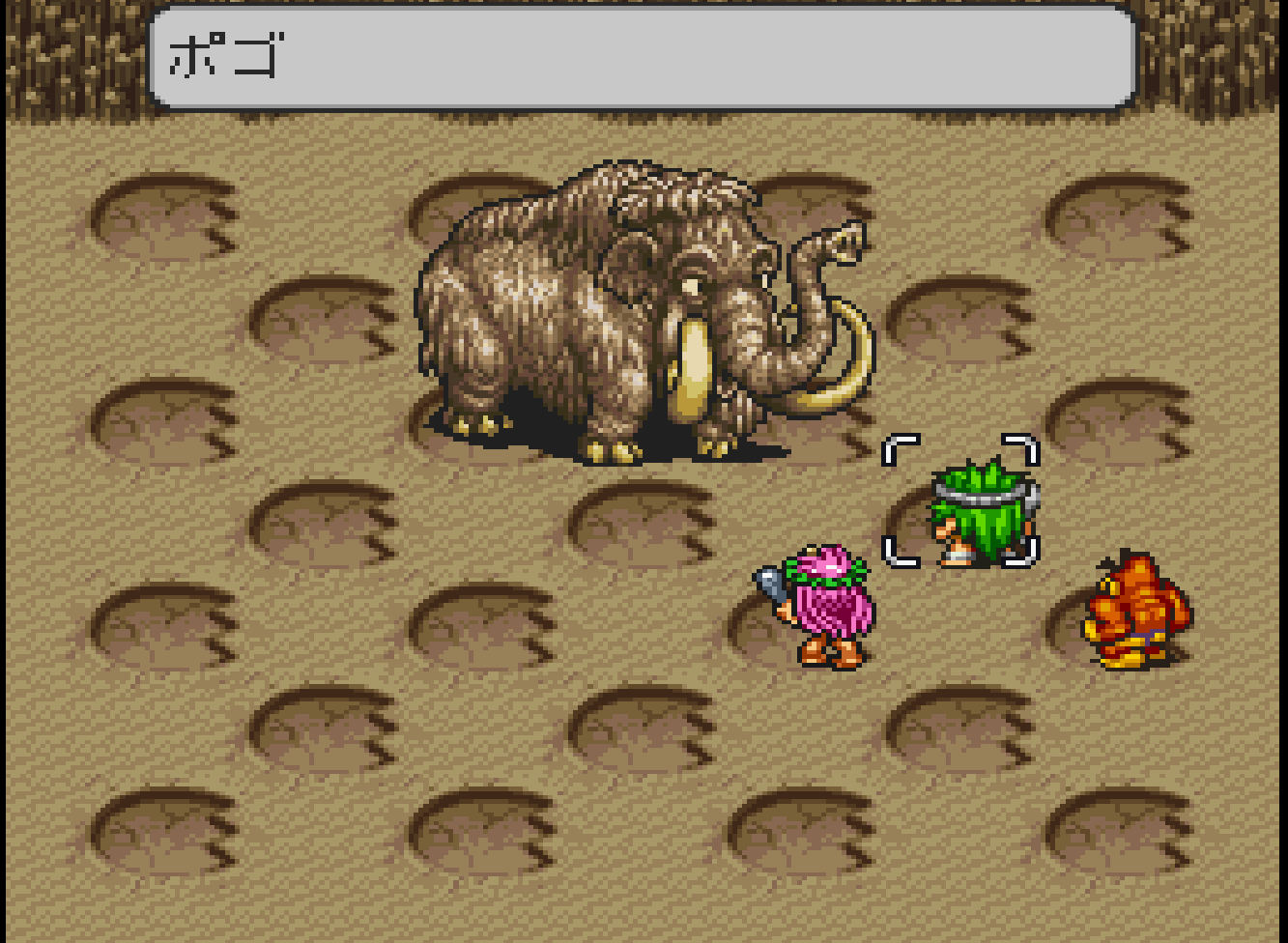
| Prehistory — "The First" | Prehistoric era | Pogo, a caveman youth | Yoshinori Kobayashi | No written dialogue; smell-based searching; item crafting | ~1–2 hours |
| Imperial China — "The Successor" | Ancient China | The Earthen Heart Shifu, an ageing kung fu master | Yoshihide Fujiwara | Train three disciples; the most-trained one inherits the school | ~2–3 hours |
| Twilight of Edo Japan — "The Infiltrator" | End of the Edo period | Oboromaru, a trainee ninja | Gosho Aoyama | Stealth infiltration; a kill counter that can end at 0 or 100 | ~2–3 hours |
| The Wild West — "The Wanderer" | American frontier | The Sundown Kid, a wandering gunslinger | Osamu Ishiwata | Set traps around a town before a timed showdown | ~1–2 hours |
| Present Day — "The Strongest" | Modern day | Masaru Takahara, a fighter | Ryōji Minagawa | Boss-rush structure; learn techniques by being hit by them | ~1 hour |
| The Near Future — "The Outsider" | Near-future Japan | Akira Tadokoro, a psychic orphan | Kazuhiko Shimamoto | Read NPCs' minds to advance; a giant robot in the finale | ~2–3 hours |
| The Distant Future — "The Mechanical Heart" | Deep space, cargo ship Cogito Ergo Sum | Cube, a maintenance robot | Yumi Tamura | Adventure-game structure; essentially no standard battles | ~1–2 hours |
| The Middle Ages — "The Lord of Dark" | Medieval kingdom of Lucrece | Oersted, a knight | Kiyofumi Katō (Square) | A deliberately classic RPG chapter — unlockable | ~2–3 hours |
| Final Chapter | Lucrece, transformed | One chosen hero (or Oersted) | — | Recruit all seven heroes; per-hero dungeons; multiple endings | ~4–6 hours |
The battle system: position, facing, charge
Every chapter uses the same core combat, and it rewards thinking in tiles.
        The 7 x 7 battlefield (schematic)

        .  .  .  .  .  .  .
        .  E  E  .  .  .  .     E = a large enemy may cover
        .  E  E  .  P  .  .         several tiles at once
        .  .  .  .  .  .  .
        .  .  .  A  .  .  .     P / A = your characters
        .  .  .  .  .  .  .     . = empty or field tiles
        .  .  .  .  .  .  .
- Turns are built from movement. On a character's turn you may move a number of tiles governed by Speed, then act — attack, technique, item, pass, or flee (which becomes Teleport for Akira, with its own quirks). Moving is never free: time passes for everyone as you move, and enemies act as their gauges fill.
- Every technique has a shape. Attacks specify a range and area — a line, a 3×3 burst, everything adjacent, one distant tile. Large enemies occupy multiple tiles; hitting any of their tiles hits them, but only once per attack.
- Facing matters. Many techniques work only in a direction, enemies have fronts and backs, and turning an enemy — or being turned — changes what can hit you.
- Charge time is the risk mechanic. The strongest techniques need one or more turns to charge, during which the user is exposed. A charging character knocked into a different tile has the charge interrupted — pushing enemies around is a defensive strategy, not a joke option.
- Field tiles are weapons. Some attacks leave elemental tiles that damage (or heal) whoever stands on them each turn. Lay them under a boss that covers four tiles; walk off them yourself.
- After battle, you recover. In the original, HP is restored after each battle, so within a fight you manage position and time; between fights, equipment and items. Healing techniques are for mid-battle emergencies — and, in Masaru's chapter, for survival itself.
- Stats are compact. Power, Speed, Vitality and IQ drive damage, turn frequency and technique strength. Levels raise them and teach new techniques, but each scenario decides how much levelling it even allows.
Chapter mechanics and secrets
| Chapter | The trick to understand | Secrets and branches worth knowing |
|---|---|---|
| Prehistory | Pogo's sense of smell is your radar: use the sniff command to locate people, animals and items, shown as scent markers. Crafting combines two materials (bones, hides, wood, stone and more) into better equipment — experiment before boss fights, because there are no shops. | The chapter is told entirely in gesture and pictorial cues. An exceptionally strong optional beast, the King Mammoth, can be encountered in the later areas; treat it as a bonus challenge, not a requirement. |
| Imperial China | The Shifu himself does not grow — his disciples do. Across three days you receive a limited set of training sessions (four per day, twelve in total in the standard count) to distribute among Lei Kugo, Yun Jou and Hong Hakka ("Sammo" in the fan translation). | Only one disciple survives: the one you trained most. That disciple inherits the ultimate technique, heads into the rival school's stronghold together with the Shifu, and — in the final duel against Ou Di Wan Lee — settles the fight alone, without the Shifu. The disciple also represents Imperial China in the Final Chapter. Decide who you want before training starts, and give them everything. Yun grows into the strongest technique-based fighter, Lei is the fastest and most reliable all-rounder, Hong the toughest physically. |
| Twilight of Edo Japan | This is a stealth game wearing an RPG's clothes. Oboromaru can hide and slip past most enemies in Ode Castle; the game counts everyone you kill. Passwords, disguised NPCs and trap mechanisms (the clockwork house of Karakuri Gennai) gate progress. | The kill counter changes the chapter: 0-kill and 100-kill clears are both recognised feats with different rewards and tone, and 0-kill demands patience — including not recruiting the prisoner from the dungeon early, since he fights on sight. A hidden passage (listen for a click in the moat corridor) leads to the optional boss Majin Ryūnosuke, whose defeat yields the powerful Muramasa blade. A pot in the castle also trades koban coins for extra techniques — bring coins. |
| The Wild West | Before the showdown, the player gathers trap materials — bottles, rope, oil, dynamite and the like — hands them to the townspeople of Success Town, and asks them to set the traps. Each assignment spends some of the limited time before the gang arrives, and matching a resident to a suitable task matters. | Every successful trap removes gang members from the final gunfight before it starts, and setting traps to thin out the Crazy Bunch makes the showdown with O. Dio considerably easier. Save before the deadline: preparation is the boss fight. |
| Present Day | A fighting-game structure: pick any of six world fighters, in any order, from a select screen. Masaru does not level up — being hit by an opponent's signature techniques teaches them to him, so losing slowly is a strategy. His Battle Cry ("Taunt" in the fan translation) heals him, which makes deliberate learning possible. | Learn first, win second: stay in each fight, at the right range and facing, until you have learned that opponent's learnable techniques — two for most opponents, but three for Jackie Iaukea, whose list includes a hidden technique (see table below). Seishi Moribe's techniques are the highest priority. After all six fall, Odie O'Bright appears — save before your last champion fight. |
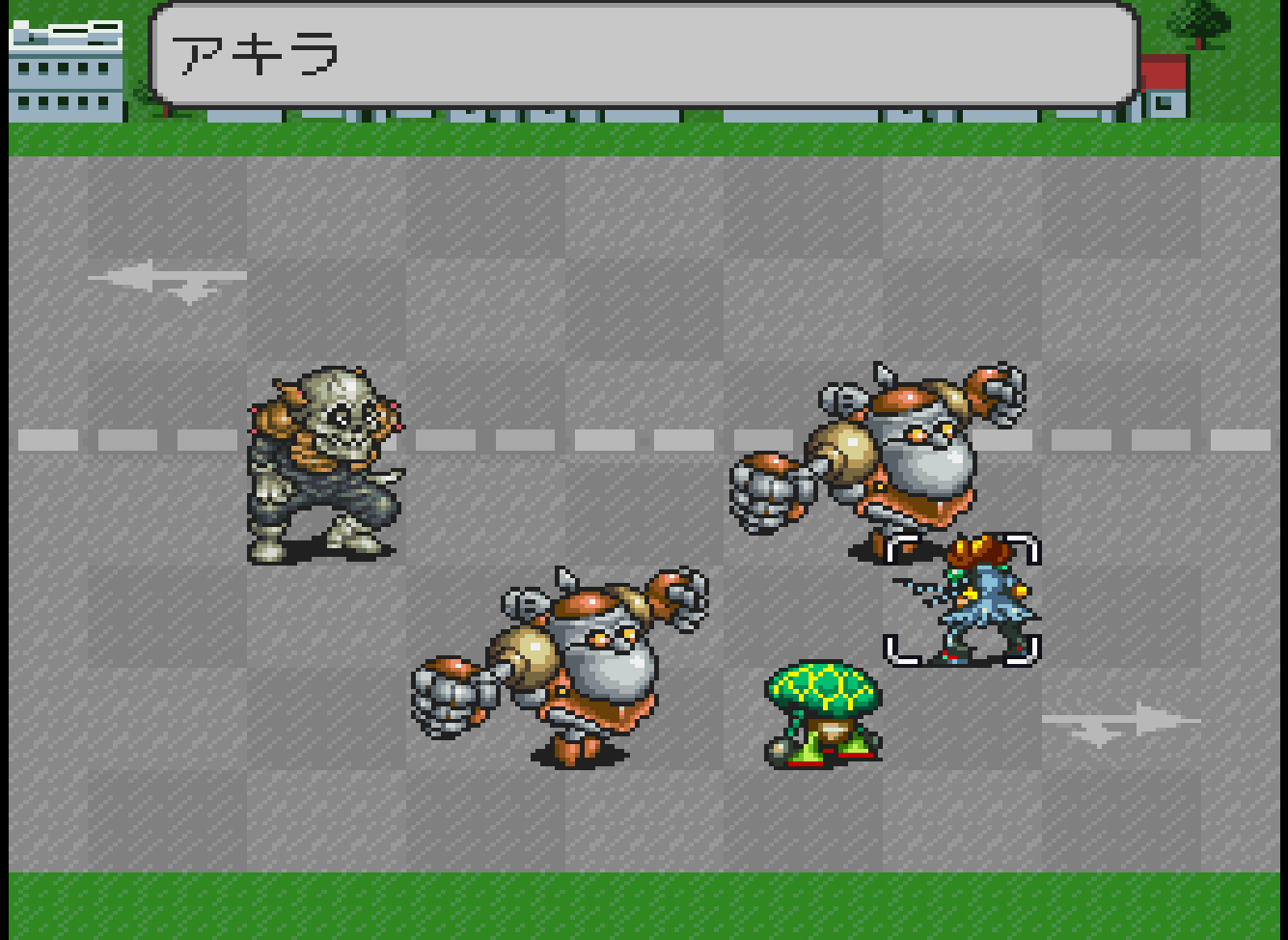
| The Near Future | Akira can read minds. Talking to NPCs often gives surface dialogue; reading the same person's thoughts gives the information that actually advances the plot and hints at secrets. | The finale has Akira pilot the giant robot the Steel Titan (Buriki Daioh) against the idol Odeo in a one-off, large-scale battle — but keep Akira's own levels and equipment in shape, because the chapter's regular bosses are fought on foot. Small optional scenes reward players who read every mind in town. |
| The Distant Future | There is effectively nothing to grind: Cube's chapter is an adventure game of exploration, logs and deduction aboard the Cogito Ergo Sum, as a transported monster gets loose and the crew turns on itself. | Cube does not gain levels here. Survival depends on paying attention — to the ship's layout, crew routines, and the computer OD-10, with which the climax is a confrontation fought through the ship's systems. Anything Cube needs for the Final Chapter comes from equipment and parts, so search the ship thoroughly. |
| The Middle Ages | A straight, classic RPG chapter on purpose: a tournament, a kidnapped princess, a demon king's castle, a fixed four-person party. Its orthodoxy is the point. | Equipment found here (including the sword Brion, at a hero's grave) matters again in the Final Chapter. The ending reframes every "Odio" you have met — and unlocks the final scenario. |
| Final Chapter | Choose one of the seven heroes as your lead — or choose Oersted, which starts an entirely different, villain-side scenario. As a hero, recruit the other six (four active party members at a time); each joins with the levels and techniques they ended their own chapter with. | Each hero has a personal dungeon in and around Lucrece holding their strongest weapon. A hidden "Aerial" equipment set, documented in Japanese guides for the original, is won from secret encounters — most famously, a monster that appears after fleeing from battle a great many times (one hundred is the figure guides give). The Sundown Kid is the hardest recruit: he keeps moving around the mountain area and must be spoken to again and again before he joins. Endings branch on your final choice about Oersted — finish him, or refuse, which leads to a last gauntlet against every incarnation of Odio. |
Present Day: the six champions and what to steal from them
Names and technique names below use the Super Famicom original's spellings; later versions and the long-standing fan translation render some differently (for example, Battle Cry appears as "Taunt" in the fan translation). Most champions have two learnable techniques; Jackie Iaukea alone has three, including a hidden one.
| Opponent | Style | Techniques to learn | Planning note |
|---|---|---|---|
| Namcat | Muay Thai | Panchama Kick; Spiral Knee | Mobile and evasive; learn his moves for your own mobility. |
| Great Aja | Professional wrestling | F Steiner; Tornado Press | Slow, high damage; a good early or late pick. |
| Tula Han | Sambo / grappling | Arm Lock; C.H. Hold | Both techniques arrive as counters — attack, and survive his replies. |
| Seishi Moribe | Koppo (bone-breaking art) | Abisegeri; Tsūda | Highest priority. Tsūda is one of Masaru's best close-range tools and a key to the final fight. |
| Max Morgan | Wrestling / heavy strikes | G Suplex; M Bomber | Heavy counter damage; heal with Battle Cry between exchanges. |
| Jackie Iaukea | Hawaiian sumo-style fighting | Aloha Harite; Oni Fudō-gaeshi; Daigekido Iwa-ban Wari (a hidden technique, and his third learnable technique) | His techniques are range-sensitive. The hidden technique is not listed before the fight and needs a specific set-up to draw out — including having his arms bound first — so treat it as a separate project from the other two. |
| Odie O'Bright (boss) | Mixed, murderous | None — nothing to learn | No weaknesses to exploit. His diving attack from a diagonal position can end the fight in one hit: never wait on his diagonals at low HP. Win with Moribe's tools (Abisegeri and Tsūda) at close range, step out, heal, repeat. |
A workable order is Jackie or Tula Han first, Moribe as soon as you can survive him, then the rest in any order — but the real rule is simpler: never finish a champion before you have learned from him.
Representative bosses, chapter by chapter
| Chapter | Final boss | What decides the fight |
|---|---|---|
| Prehistory | Odo, the dinosaur god | Crafted equipment and a full party; a straight fight after a gear-driven chapter. |
| Imperial China | Ou Di Wan Lee, master of the rival school | The path through the stronghold is fought together with the Shifu, but the final duel itself is the chosen disciple's alone, fought with the freshly inherited ultimate technique. |
| Edo Japan | Ode Iou, the demon daimyo | The form changes mid-fight; your kill-count choices decide how strong you arrive. |
| Wild West | O. Dio, leader of the Crazy Bunch | Decided before it starts — by how many of his gang your traps removed. |
| Present Day | Odie O'Bright | Positioning discipline, and how many techniques you bothered to learn. |
| Near Future | Odeo, the idol of enforced peace | A one-off giant-robot duel in the Steel Titan. |
| Distant Future | OD-10, the ship's computer | Attention, not levels: a systems confrontation. |
| Middle Ages | The "Lord of Dark" — and then Streibough | A classic party boss fight, then the chapter's real duel. |
| Final Chapter | Odio, in his true form | A full party, personal-dungeon weapons, and the choice of whether to spare Oersted. |
A first-timer's route through the game
1. Start with Prehistory. It teaches movement, range and crafting in about an hour. 2. Play Imperial China early and commit. Pick your successor disciple on day one and never split training sessions. 3. Treat Edo Japan as two games. A normal first clear; the 0-kill and 100-kill clears are replay goals. 4. In the West, spend every minute on traps. The trap count is your real attack stat in the finale. 5. Do Present Day late. It is the shortest chapter and the least forgiving of sloppy positioning. 6. In the Final Chapter, recruit everyone and run every personal dungeon first. The best weapons are the difficulty setting. 7. Save in multiple slots at chapter boundaries — before the last Present Day champion, before the Edo routes diverge, and before choosing your Final Chapter protagonist.
Who It's For
Players who prefer several short, complete RPGs to one long one; tactics fans who want positioning and charge management in a story RPG; and anyone curious how experimental a mainstream 1994 Square release could be. Completionists get unusual value: kill-count routes, a choice of successor, two Final Chapter perspectives and multiple endings repay a second run. If you want one continuous 40-hour narrative with a single persistent party, this structure will feel fragmented by design — the fragments are the point.
How to Play It Today
The original is a Japanese Super Famicom cartridge, so playing the 1994 version itself means import hardware (or a compatible setup) and reading Japanese; a well-known unofficial English fan translation also exists. For most readers, the practical modern route is the HD-2D remake, released first for Nintendo Switch in 2022 and later for PlayStation 4, PlayStation 5 and PC: a faithful expansion with voice acting, visible health and charge gauges, and small differences — including an extra final-boss sequence that does not exist in the original. Strategy in this article describes the Super Famicom original; where the remake differs, your remake copy wins.
Related Reading
- Seiken Densetsu 3 (Trials of Mana) — Square's other great Japan-only Super Famicom RPG of choice and consequence
- Our retro RPG coverage and more Super Famicom strategy features
Editorial note: Basic specifications (internal title, capacity and memory configuration) are based on checking the cartridge header information. Strategy content is described from published sources.
Game screenshots captured by the author. ©SQUARE ENIX.
Watch the official video
This is Nintendo’s official Japanese-language footage of the original Super Famicom release, shown on Virtual Console, not a remake.
YouTube connects only after you select “Load video”. Playback does not start automatically. Google’s Privacy Policy applies after connecting. Google Privacy Policy
Find original hardware editions on eBay
As an eBay Partner Network affiliate, Enkeisha may earn a commission from qualifying purchases made through these links.
Search eBay listings (affiliate link)
Check the language, region, hardware compatibility, condition and authenticity before buying. Search results may include reproductions; links do not endorse individual sellers.