Kamaitachi no Yoru — The Night the Snow Closed In, and a Novel Learned to Branch
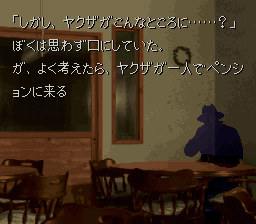
A ski trip, a small pension in the mountains of Nagano, and a blizzard that cuts the lodge off from the outside world. Then a note appears: tonight, at midnight, someone will die. Kamaitachi no Yoru (1994) is the Super Famicom sound novel that turned that simple, terrifying setup into one of the best-selling adventure games of its era — a full-length mystery you read, presented as text over digitised photographs, with blue silhouettes for people and a branching structure that keeps rewriting the story every time you finish it.
Spoiler policy for this article (please read first): this guide covers branch structure and unlock conditions only. It does not name the culprit, reveal motives, or explain the core trick of the mystery. Where an ending condition touches the deduction itself, it is described in deliberately general terms ("reach an accusation point and answer correctly") so that nothing essential is given away. You can read everything below before your first playthrough.
Quick Facts
| Item | Detail |
|---|---|
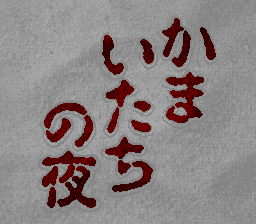
| Original title | かまいたちの夜 (Kamaitachi no Yoru) |
| English title | No official English title for the Super Famicom original; the later iOS version was released in English as Banshee's Last Cry (2014) |
| Platform | Super Famicom |
| Release date | November 25, 1994 (Japan) |
| Developer | Chunsoft |
| Publisher | Chunsoft |
| Genre | Sound novel (visual novel) / mystery adventure |
| Scenario | Takemaru Abiko |
| Cartridge size | 24 Mbit |
| Original price | ¥10,800 |
Overview
Kamaitachi no Yoru was Chunsoft's second "sound novel," following Otogirisō (1992). The label was Chunsoft's own coinage for a game that is, quite literally, a novel with sound: the story is told as full-screen text laid over still background images, accompanied by music and sound effects, and the reader advances the text with a button press. At intervals the text stops and offers choices. Those choices do not merely decorate the story — they redirect it, sometimes subtly, sometimes into an entirely different genre.
The premise is a classic closed-circle mystery. The protagonist, Tōru, travels with his girlfriend Mari to a pension called Spur in Nagano for a skiing holiday. A snowstorm seals the lodge. A threatening note is discovered, a guest is killed, and with no way to contact the outside world, the people inside have to live alongside the possibility that one of them is responsible. From there, everything depends on what you choose to notice, whom you choose to trust, and what you do with the information each route gives you.
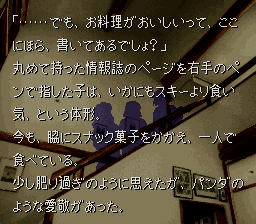
Two presentation decisions define the game visually. First, the backgrounds are digitised photographs of real locations rather than pixel art — the development team photographed an actual pension (the lodge Knulp in Nagano) and used it as the setting. Second, the characters are shown as flat blue silhouettes. The silhouette idea came late in development, suggested by scenario writer Takemaru Abiko: because every figure is a shadow, every figure is, visually, a suspect. Each silhouette is nonetheless drawn distinctly enough that you can tell the guests apart at a glance, and the device keeps the mystery fair — the game never hides a character's presence, only their intentions.
The script was written by Takemaru Abiko, a published mystery novelist whom Chunsoft approached after Otogirisō players asked for a proper mystery next. Abiko spent around two years on the branching script, working in Chunsoft's office during debugging to keep the proliferating branches consistent. The music and sound effects, by Kota Kato and Koji Nakajima, were composed unusually early — Kato was simply handed the script and asked to write music for "snow" and "fear" before any images existed. The result is a soundtrack that leans on silence, wind, and low, pulsing dread rather than melody, and it became so associated with menace that tracks from the game were later reused by Japanese television in unrelated documentary contexts.
Structurally, the cartridge holds far more than the central mystery. The main story — the Mystery chapter — is only the first layer. Finishing it opens sub-scenarios that retell the same holiday in completely different genres, and completing those opens parody and puzzle scenarios hidden behind the game's famous coloured bookmarks. The Strategy Essentials section below maps that whole structure without spoiling any of it.
Why It Still Matters
First, the numbers. The Super Famicom version sold roughly 750,000 copies in Japan — an extraordinary figure for a text-driven adventure game on a cartridge, at a premium price of ¥10,800, in the same season that 3D consoles were arriving. Japanese sources describe the result as a "sound novel syndrome": publishers across the industry rushed to make their own text adventures, and "sound novel" passed from a Chunsoft trademark into the name of a genre. If you trace the family tree of the modern visual novel, this game is one of the thick branches near the trunk. Developers such as Kotaro Uchikoshi (999, the Zero Escape series) and Jiro Ishii (who went on to make 428: Shibuya Scramble, also written by Abiko) have cited its influence, and in a 2017 Famitsu reader poll of favourite adventure games it still placed sixth, more than two decades after release.
Second, the design ideas were ahead of their time. The game treats endings as content unlocks: the more endings you have seen, the more choices appear at branch points you have already visited, so a replay is not a repeat but a wider version of the same book. It asks the player to type the culprit's name freely at the climax instead of picking from a list — a design decision Abiko and director Kazuya Asano insisted on precisely so the mystery could not be solved by brute-force elimination. And it hides content behind total-completion states (the pink and gold bookmarks) in a way that made the bookmark itself a status symbol among Japanese players in 1994, complete with a real-world prize campaign run by Chunsoft.
The afterlife of the cartridge also explains its reputation. The game was ported repeatedly — to PlayStation in 1998 (with two additional scenarios written for that version), to Game Boy Advance in 2002, to phones, and to the Wii and Wii U Virtual Consoles — and it founded a series, with a full sequel in 2002 and a third entry in 2006. Yet the ports also clarify what was special about the original package: the sequels and remakes grew more elaborate, added flowcharts and illustrated characters, and in doing so traded away some of the stark, photographic dread of 1994. The Super Famicom version remains the reference point precisely because its limitations forced the solutions — silhouettes, photographs, sound, typography — that made it famous.
Third, it remains a masterclass in atmosphere on minimal hardware. There is almost no animation. There are no character portraits with changing expressions — only silhouettes, photographs, typography, wind noise, and a screen that, at the programmers' deliberate design, very slowly and subtly darkens as tension rises. Few horror or mystery games on any system do so much with so little, which is why the Super Famicom original is still the version many fans recommend first, even over later remakes that replaced the silhouettes with illustrated characters.
Highlights
- A real mystery, fairly clued. The Mystery chapter is a genuine whodunit written by a working mystery novelist. Routes that end badly are not wasted time: they hand you information — about the lodge, the guests, and the timeline — that the successful route assumes you have absorbed. The game is designed to be solved by a reader who pays attention across several readings, not by a player who guesses well once.
- Silhouettes and photographs. The digitised real-world backgrounds give the pension a mundane, believable texture that pixel art could not, and the blue silhouettes turn every conversation into a line-up. It is a solution to a technical limitation that became the game's visual signature.
- A book that grows. New choices materialise at old branch points as you collect endings, sub-scenarios in new genres sprout from familiar scenes, and the joke scenarios hidden behind the pink bookmark gleefully dismantle the story you just took seriously. Finishing the game the first time is closer to reaching the halfway point.
- Sound as the special effect. Blizzard wind, muffled footsteps in snow, a scream recorded by the development staff in a conference room — the audio does the work that animation does in other games, and the Super Famicom's sound chip is pushed toward atmosphere rather than tunes.
Strategy Essentials
Everything in this section is structural. It tells you how the game branches, what kind of decision each branch point asks for, and what you must have done to open each layer of content. It never tells you which choice is "right" in the deduction itself, and it never names names.
1. The four kinds of choice
Not all choices in Kamaitachi no Yoru do the same job. Learning to recognise which kind you are looking at is the single biggest improvement a new player can make, because the game deliberately mixes them in the same menus.
| Choice type | What it looks like | What it actually does | How to approach it |
|---|---|---|---|
| Route choices | "Go and look at X" / "Stay here" / "Follow Y" | Moves you between scenes and information sources; the main steering wheel of the investigation | Treat as information gathering. A route you have not taken is a room you have not searched |
| Attitude choices | How Tōru responds to a person or a remark | Often changes tone and dialogue rather than destination — but can quietly open or close later options | Play them honestly on a first run; vary them on replays when a scene feels unchanged |
| Deduction choices | Questions about the case, and at key moments a free name-entry prompt | Tests what the player has understood. The climactic accusation is typed, not selected | Never guess-and-reload. If you cannot justify the answer from things the text showed you, you are missing a route |
| System choices | Name settings, and at least one famous interaction with the hardware itself | A small number of hidden routes are tied to actions outside the menus, including the console's reset button | If a scene seems to invite an action the menu cannot express, think about the hardware in front of you |
The name-entry accusation deserves emphasis. Because the answer is typed freely, the game can accept far more than the correct name — wrong names, joke names, and names of people (and animals) who could not possibly be responsible are all recognised, and many lead to their own writing. Do not treat the prompt as a formality at the end of a checklist. It is the exam the whole book has been setting, and Abiko designed it specifically so that elimination and brute force would fail.
2. The shape of a playthrough
The Mystery chapter follows a consistent dramatic shape, and the branches hang off it like side passages off a corridor. The diagram below describes the shape only — the phases every route passes through — not any solution.
ARRIVAL            The lodge, the guests, the storm closing in
   |
THE NOTE           A threat is discovered; the holiday changes meaning
   |
THE INCIDENT       The crime the note promised
   |
INVESTIGATION  <-> Information loops: scenes, conversations, re-reading.
   |               (Choices here decide WHAT YOU KNOW, and new options
   |                appear in these passages as you collect endings.)
   |
ACCUSATION POINT   Deduction choices, including free name entry
   |
   +---> RESOLUTION ending (credits) --> unlocks begin (see table below)
   |
   +---> BAD / SHORT endings ----------> read the clues they gave you,
                                          then re-enter via chapter select
Three systems make this loop comfortable rather than punishing. You can fast-forward through text you have already read, rewind to re-read passages you have just passed, and once you reach any ending you can re-enter the story by chapter instead of starting from the first page every time. Later ports added a full flowchart screen; the Super Famicom original does not have one, which is worth knowing before you start — your memory, and the notes you take, are the flowchart.
3. Endings and unlock conditions
This is the heart of the game, and the part most guides spoil. The table below gives conditions in spoiler-safe language. "See an ending" means reach the end of that branch; the game distinguishes full resolution endings (which roll credits) from shorter endings, and both kinds count toward your collection.
| Layer | Content | Unlock condition (spoiler-safe) | Notes |
|---|---|---|---|
| 1 | Mystery chapter | Available from the start | The central whodunit. Several endings of different kinds |
| 2 | Spy chapter | See a credits (resolution) ending in the Mystery chapter at least once; new options then appear inside familiar scenes | A suspense/action retelling with the same cast in different roles |
| 2 | Evil Spirit chapter | Same gateway as above: progress after a first Mystery resolution opens the sub-scenario branches | An occult-horror retelling |
| 2 | Further sub-scenarios (including the "Kamaitachi-tachi" chapter and the Snow Labyrinth chapter) | Open up as you accumulate endings across the Mystery and sub-scenarios | Shorter, stranger variations; exact gating order varies between guides |
| 3 | Pink bookmark | Read all endings — resolution and bad — of the Mystery chapter and the sub-scenarios | Your save "bookmark" turns pink. English references commonly count 21 endings in the original release up to this structure |
| 3 | O's Comedy chapter; Cipher chapter | Granted by the pink bookmark | Self-parody comedy, and a code/treasure-hunt scenario that requires solving a cipher hidden along the way |
| 4 | Hidden routes (including the Chunsoft Conspiracy chapter and the Strange Pension chapter) | Found inside the pink-bookmark content; one is effectively the gateway to the gold bookmark | The game's last and most playful layer |
| 5 | Gold bookmark | Read every text in the game — not just every ending | In the Super Famicom version this was famously close to exhaustive; Chunsoft's original campaign offered a real lodge voucher to the first players who photographed a gold bookmark and sent it in |
Two cautions belong on the record. First, the total ending count is counted differently by different sources: English references commonly cite 21 endings for the original release's main structure, while some Japanese guides count 43 endings for the Super Famicom version when every branch behind every bookmark is included. Both numbers circulate because they are counting different sets; this article therefore gives conditions, not a single definitive total. Second, scenario names above follow the game's official strategy guide tradition; ports rename or reorganise some chapters, and the PlayStation version adds two scenarios of its own, so a guide written for a port will not match the Super Famicom cartridge exactly.
A practical consequence of the pink bookmark, unique to this version: once the bookmark turns pink on the Super Famicom, you can no longer change the protagonist's and heroine's names on that save. If custom names matter to you, settle them early.
4. Habits that solve the mystery faster
- Take real notes. Who was where, and when, is the substance of the case. The game will not summarise it for you, and the Super Famicom version has no flowchart screen. A page of handwritten timeline notes is the intended peripheral.
- Read the bad endings properly. Do not button-mash through a failing route to get back to the branch point. Failed routes are where the game deposits the clues, the character background, and the timeline corrections that the resolution route expects you to know.
- When stuck, widen before you deepen. If an accusation point keeps defeating you, the answer is almost never a different guess — it is a route you have not read. Go back to the investigation phase and take the corridor you skipped.
- Revisit old branch points after every new ending. The option lists grow. A menu you have already "finished" may now contain the choice that opens a sub-scenario, and the game does not announce the addition.
- Use rewind instead of reloading. The rewind function exists for deduction: when a conversation reveals something important, step back and read it again in context rather than relying on memory.
- Expect the joke content to be real content. The parody chapters are not throwaway extras; at least one hidden route and the gateway to the gold bookmark sit inside them. Completionists should treat the pink-bookmark scenarios as mandatory reading.
- Treat the bookmark as your progress bar. The bookmark is your save data and its colour is your progress record. Watching it change — standard, pink, gold — is the game's own progress bar, so check it on the title screen whenever you return.
5. How to think during the investigation
Because the deduction is examined rather than selected, it helps to read the investigation phase the way a mystery novelist constructs it. Abiko has said that the choices were designed to be clear to a reader who already understands the truth, without functioning as hints to a reader who does not — which means the text rewards a particular kind of attention. Three questions, asked continuously, will carry most readers most of the way:
| Question to keep asking | Why it matters in this game |
|---|---|
| Where was everyone when the key events happened? | The lodge is a fixed space with a fixed cast. Routes differ largely in which movements you witness, so your personal timeline is the real inventory of clues |
| What did I learn in this route that no other route told me? | Information is deliberately distributed across routes, including failed ones. A fact that appears exactly once is usually load-bearing |
| Is this scene giving me a fact, or giving me a feeling about a person? | The game separates evidence from atmosphere carefully. Accusations built on atmosphere are the ones the name-entry prompt punishes |
One more structural point is worth knowing before the late game: several of the most important branches are quiet. They are not marked as dramatic decisions, and the menu wording can look almost identical between a first reading and a later one, with a single added option doing all the work. When you return to a familiar passage with new endings banked, read the whole menu again instead of selecting from memory. Players most often stall not because they chose wrongly, but because they never noticed the menu had changed.
Who It's For
Kamaitachi no Yoru is for readers first and players second. If you enjoy classic closed-circle mysteries — a lodge, a storm, a fixed cast, a fair set of clues — this is one of the finest examples the 16-bit era produced, and its branching structure does something a printed novel cannot: it lets you live inside the wrong theories before you earn the right one. It is also essential for visual novel historians, because so much of what the genre later standardised (multiple routes as jigsaw pieces, completion-gated truth, comedy unlock chapters) is visible here in early, confident form.
It is less suited to players who want action, animation, or a story that resolves in one sitting on one route. A first resolution can take an evening of reading; the full bookmark structure is a much longer commitment. And a practical note for English readers: the Super Famicom original is entirely in Japanese. The official English localisation, Banshee's Last Cry, belongs to the later iOS remake, which renames characters and relocates the setting — an excellent way to experience the mystery, but a different text from the 1994 cartridge this article covers.
How to Play It Today
- Original cartridge: The Super Famicom cartridge (24 Mbit, battery-backed saves) is common on the Japanese second-hand market and runs on a Super Famicom or a Super NES with the cartridge-slot tabs addressed or an adapter. Because saves are battery-backed, expect that a cartridge of this age may eventually need its battery serviced to keep bookmarks safe.
- Virtual Console (historical): The game was sold on the Wii Virtual Console (2007) and the Wii U Virtual Console (2013) in Japan. Both storefronts have since closed, so these are only playable if already purchased on a surviving console.
- Modern collection: Kamaitachi no Yoru ×3 (Nintendo Switch / PlayStation 4 / Steam, September 19, 2024, Spike Chunsoft) includes the main scenarios of the first two games alongside the third, and lets players switch the presentation toward the original's sound and visuals — currently the most convenient official way to read the first game's main story on modern hardware, in Japanese.
- In English: Banshee's Last Cry for iOS (Aksys Games, 2014) is the official English version of the remake line. Check current store availability in your region before planning around it, as listings for older mobile titles change.
Find the original Japanese cartridge
Disclosure: The Rakuten and Yahoo! Shopping links are standard shopping links. Enkeisha does not earn a commission from purchases made through these links.
Find original hardware editions on eBay
As an eBay Partner Network affiliate, Enkeisha may earn a commission from qualifying purchases made through these links.
Search eBay listings (affiliate link)
Check the language, region, hardware compatibility, condition and authenticity before buying. Search results may include reproductions; links do not endorse individual sellers.