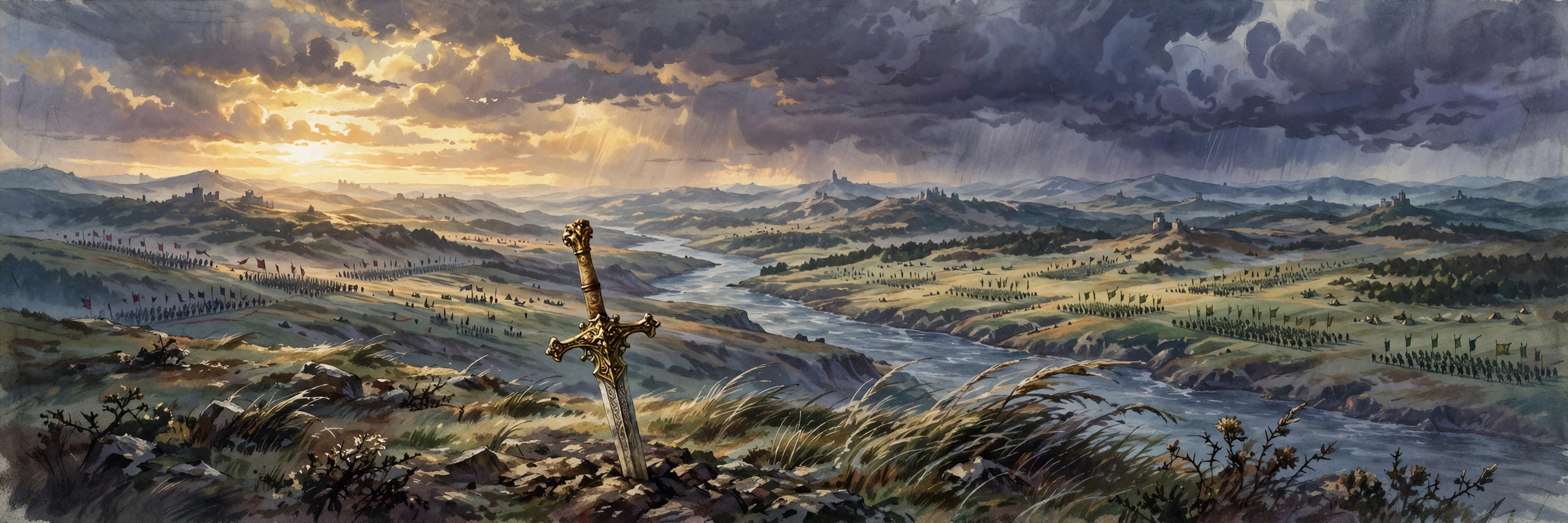
Every long-running series has one entry that fans describe with a mixture of pride and warning. For Fire Emblem, that entry is Thracia 776. Released at the very end of the Super Famicom's life — and never officially released outside Japan — it is a small, desperate war story nested inside the much larger war of its predecessor, Fire Emblem: Genealogy of the Holy War. Prince Leif does not command a grand allied army here. He commands fugitives, villagers, thieves and tired knights, and the game systems make you feel it: your soldiers get exhausted, your weapons mostly come from the enemy's hands, and even a healing staff can miss.
That harshness is exactly why the game still matters. Thracia 776 introduced or refined ideas — capturing, rescuing, fatigue, leadership stars, fog of war — that shaped the series for decades. This guide explains how those systems actually work, which units carry a run, and which chapters will test you, so that a first playthrough is challenging in the intended way rather than confusing.
Quick Facts
| Item | Detail |
|---|---|
| Title | Fire Emblem: Thracia 776 (ファイアーエムブレム トラキア776) |
| Platform | Super Famicom (Japan only) |
| Developer | Intelligent Systems |
| Publisher | Nintendo |
| Release (Nintendo Power flash-cart service) | September 1, 1999 (Japan) |
| Release (boxed cartridge) | January 21, 2000 (Japan) |
| Genre | Tactical / strategy RPG |
| Series position | 5th main entry; interquel to Genealogy of the Holy War (set in Grann 776, during that game's second generation) |
| Playable characters | 52 in total; at most 47 in a single playthrough (several are mutually exclusive choices) |
| Later re-releases (Japan) | Wii Virtual Console (July 15, 2008), Wii U Virtual Console (July 10, 2013), New Nintendo 3DS Virtual Console (November 28, 2016) |
| Official English release | None |
Overview
Thracia 776 is a midquel. Its events run alongside the second generation of Genealogy of the Holy War, in the Thracian Peninsula of Jugdral, during the year Grann 776. Leif, the exiled prince of Leonster, begins with almost nothing: a handful of Fiana Freeblades, a village militia's worth of weapons, and an empire occupying his homeland. The early chapters are a flight and a prison break; the middle chapters are a guerrilla campaign; only late does the story become the liberation war its title promises.
Structurally, designer Shouzou Kaga — directing his final Fire Emblem — used the smaller scale to experiment. Maps have sharply varied objectives: seize, escape, defend, survive. Indoor maps force mounted units to dismount and fight on foot with swords. Fog of war appears here for the first time in the series. And the economy is deliberately broken in the player's disfavour: shops are scarce and expensive, arenas are risky, and the intended way to equip an army is to take weapons from enemies — literally, by capturing them.
Why It Still Matters
First, Thracia 776 is the series' great systems laboratory. Rescue — carrying an ally out of danger — debuted here and became a permanent series staple. Capture never became standard, but it remains the boldest answer any Fire Emblem has given to a real tactical question: what if defeating an enemy and using an enemy were different decisions?
Second, its difficulty is systemic rather than inflated. Enemies are not simply given bigger numbers; instead, the game layers small pressures — fatigue, staff inaccuracy, leadership bonuses, terrain, reinforcements, a displayed hit range that is capped at 1–99% so no attack is ever certain — until ordinary-looking maps demand genuine planning. Modern hard modes still chase this feeling.
Third, its storytelling scale is unique in the series. Where Genealogy is an epic of holy bloodlines, Thracia is a ground-level story about hunger, occupation and a prince who is, frankly, not ready. Many fans consider it the best-written of the Kaga-era games precisely because its mechanics and its fiction say the same thing.
Highlights
1. Capture changes every decision. Any strong enemy is also a walking supply crate — if you can take them alive. Bosses included: several can be captured, stripped, and released, which is often more profitable than killing them.
2. The Manster arc (Chapters 4–6). Stripped of your army and equipment, you escape a prison city chapter by chapter. It is the series' most famous early-game gauntlet and teaches every core system under pressure.
3. Staves are the late game's real weapons. Warp, Rescue, Sleep, Silence, Berserk and Rewarp dominate the final third, on both sides. Thracia is often described, only half-jokingly, as a game about staff users duelling each other across the map.
4. Build-your-own units. Crusader Scrolls, skill manuals, stat-boosting rings and the hidden PCC multiplier (below) mean two players' versions of the same character can play completely differently.
Strategy Essentials
1. Chapter Structure — Read This Before You Start
Sources count this game's chapters in different ways, so here is the full picture rather than a single number:
| Counting method | Count | What it includes |
|---|---|---|
| Numbered main chapters, one route | Chapters 1–24 + Final Chapter ("Sworn Upon a Sword") | The spine of the story; often summarised as "25 main chapters" |
| Gaiden (side) chapters | 8 — Chapters 2x, 4x, 8x, 11x, 12x, 14x, 21x, 24x | Optional; each has an entry condition in a previous chapter (e.g. saving NPCs, visiting houses) |
| Route split | Chapters 16A/17A or 16B/17B | After Chapter 15 you take one of two two-chapter routes; they rejoin at Chapter 18. Different units join on each route |
| Total distinct chapters in the game data | 35 | 27 numbered/route/final chapters + 8 gaiden chapters |
| Chapters in one full playthrough | Roughly 31–33 | Depends on how many gaiden chapters you unlock |
Practical advice: gaiden chapters are not filler. They contain Crusader Scrolls, promotion items, recruitable characters and — in 21x — the only chance to recover units who were captured or left behind earlier. Check each chapter's gaiden condition before you clear it.
2. Fatigue — Your Best Unit Has a Stamina Bar
| Element | Rule |
|---|---|
| What raises Fatigue | Combat, using staves, dancing, stealing and similar actions; roughly +1 per action, more for powerful staves |
| The limit | A unit whose Fatigue has built up cannot deploy in the next chapter and needs a chapter of rest (sources differ in how they phrase the boundary against maximum HP, so this guide does not assert an exact threshold) |
| The exception | Leif never sits out — he is deployed in every chapter regardless |
| Recovery (rest) | Sitting out one chapter resets Fatigue to 0 |
| Recovery (item) | A Stamina Drink (S Drink) used in battle preparations removes Fatigue and lets the unit deploy anyway. S Drinks are rare — treat them as emergency stock |
| When it starts | The system becomes relevant from the mid-early game onward, once deployment choices begin |
How to play around it: rotate two "teams" for low-stakes chapters, rest staff users deliberately before staff-heavy maps, check the Fatigue column (second page of the status screen) during preparations, and never let your only Warp user and your only healer be exhausted in the same chapter. Fatigue is also why Thracia rewards training a wide roster instead of one super-unit — the game will simply bench your super-unit.
3. Capture — The Economy Runs on Prisoners
| Step | How it works |
|---|---|
| Requirement | The attacker's Build must exceed the target's Build. Mounted enemies cannot be captured — put them to sleep (Sleep staff) to force a dismount first |
| The attempt | Choose Capture instead of Attack. Your unit fights with most stats halved during the attempt — and stays penalised while carrying the prisoner |
| Success | Reduce the enemy to 0 HP in that combat and you capture instead of kill. Unarmed enemies can be captured outright |
| Loot | Use Trade with the prisoner to take everything: weapons, staves, items, even vulneraries. This is your main source of good equipment and money (sell the surplus) |
| Release | After looting, Release the prisoner to restore your stats. There is no gameplay reward for releasing — it is purely to free your unit |
| Recruitments | Some characters can only be recruited by capturing them (for example Lifis, Salem and Misha), so capture first and check before you loot-and-release a boss |
Capture and Rescue are sibling systems with the same logic and the same stat penalties: Build decides who can carry whom, a carrier's stats are halved, and a heavy passenger can halve the carrier's movement. The dark mirror: enemies can capture your units too. If an enemy carries a captured ally off the map, Chapter 21x is the opportunity to rescue them — and on escape maps, anyone still on the map when Leif escapes counts as captured. On escape chapters, Leif always goes last.
4. The Stars and the Hidden Multiplier — Thracia's Invisible Stats
| System | Effect | Notes |
|---|---|---|
| Leadership Stars (指揮星) | +3 Hit and +3 Avoid per star to every unit of that side on the map | Shown on the status screen. Leif's total rises with story support from his advisors. Enemy totals matter too — see Chapter 22 below |
| Movement Stars (移動星) | +5% chance per star for the unit to act again after finishing their turn | Pure upside, but never plan a turn that requires it to trigger |
| PCC / FCM (追撃必殺係数) | On a follow-up (doubling) attack only, critical rate = (displayed Crit − enemy's crit-avoid) × PCC | Hidden in the original release. Non-follow-up attacks cap displayed crit at 25. PCC ranges 0–5 for playable units: a PCC of 5 turns a modest crit rate into a near-guaranteed follow-up crit; a PCC of 0 means follow-ups never crit beyond the cap logic |
| Crusader Scrolls (聖戦士の書) | 12 scrolls. While held in inventory: negates enemy critical hits (except Wrath-triggered crits) and modifies growth rates | Each scroll's growth changes net to about +30% spread across stats, some with a negative (e.g. Höðr: HP +30%, Str +10%, Luck −10%). Bonuses from multiple scrolls stack — pass scrolls to whoever is about to level up |
Rule of thumb: give scrolls to the unit levelling next, park a scroll permanently on any fragile unit standing on the front line (crit immunity is the real prize), and favour high-PCC units when handing out Killer weapons and crit-boosting supports.
5. Yes, Staves Can Miss
In Thracia 776, even healing staves can miss:
| Element | Rule |
|---|---|
| Accuracy and Skill | Low Skill can make even healing staves miss, so raising your staff users' Skill matters |
| On a miss | The staff use is not consumed, and the user still gains experience and weapon experience — annoying, not catastrophic |
| Double-casting | Heal, Mend and Physic can trigger an additional heal. However, if the first cast restores the target to full HP, no additional heal occurs |
Practical advice: raise Skill on your staff users (the Ullr Scroll helps), don't build a turn plan that collapses if one Heal misses, and respect enemy staff users for the mirror reason — status staves such as Sleep and Berserk have unlimited duration until cured with Restore, which is why the late game becomes a staff duel.
6. Key Units
| Unit | Joins | Role and why they matter |
|---|---|---|
| Leif | Chapter 1 | Lord; deploys every chapter and is immune to enemy status staves. Light Brand gives him a 1–2 range magic option. PCC 2. Promotes after Chapter 18 — late, so feed him scroll-assisted levels early |
| Finn | Chapter 1 (leaves after Ch. 3, rejoins Ch. 7) | Lance knight with the Brave Lance and the Miracle skill. Your early boss-killer; his absence and return structure the early game |
| Eyvel | Chapter 1 (unavailable after Ch. 5; can return in Ch. 24x) | Pre-promoted Swordmaster who carries the opening chapters while your trainees grow. What happens to her is the emotional spine of the Manster arc |
| Dagdar | Chapter 1 (rejoins Ch. 8x) | Pre-promoted Warrior with huge Build — your first reliable capture unit for heavy enemies and bosses |
| Osian | Chapter 1 | Axe fighter with the personal Pugi axe and Wrath; PCC 3. One of the best early combat units if given scroll support |
| Safy | Chapter 3 (requires Ch. 2x cleared) | First dedicated staff user; her personal Repair staff repairs a broken weapon — save it for a Warp staff or a personal weapon. She is also the key to recruiting Shiva (Ch. 7) and Tina (Ch. 12x) |
| Asbel | Chapter 4x | Young mage with the personal Grafcalibur tome (high might, high crit) and PCC 3. The classic "train him and he deletes the mid-game" unit |
| Fergus | Chapter 4 | Free Knight whose PCC of 5 is his headline stat: on a follow-up attack he will almost always crit, especially with a Killing Edge. Supported by Karin, and one of the best combat units of the Manster arc who stays relevant all game |
| Karin | Chapter 4 | Pegasus Rider. Indoors she is hindered, but outdoors she is your first flier: she can ferry unmounted units toward escape points and visit villages other units cannot reach. Her combat needs investment; her utility does not |
| Lara | Chapter 4 | Thief utility first — lockpicks and chests. In Chapter 12x she can talk to Perne and class-change into the game's only Dancer, able to refresh a staff user or a combat unit for a second action each turn |
| Tina | Chapter 12x (talk with Safy) | Safy's younger sister, with two personal staves: Thief and Unlock. Thief lets her take items from distant enemies, which is how pristine copies of powerful staves change hands. Her low starting Magic and Skill mean her staves can miss until she is trained |
| Sara | Chapter 16B (talk with Leif) or Chapter 17A (visit the church) | A project staff unit with the Paragon, Wrath and Miracle skills and excellent growths. Raised to A-rank staves she handles the game's best staves, and as the only unit who can use the Kia staff she is required for Chapter 24x |
| Saias / Ced | Chapter 23 (one or the other) | The late-game choice. Saias brings A-rank staves and leadership stars that lift the whole army's Hit and Avoid; Ced is the combat option, known for his powerful personal tome. Either way, your late-game staff game gets stronger |
7. Chapters That Will Test You
Chapters 4–6 — the Manster escape. You start stripped of army and equipment. Capture to re-equip, and on escape maps always send Leif out last. Learn the game's manners here and the rest of the campaign gets much more readable.
Chapter 14 — the defence of Tarrah. The series' first defend map: hold the gate for 10 turns. Do not be intimidated by the enemy count; block the entry points and defend. Visiting at least three houses inside the city, other than Homer's house, meets the condition for the following gaiden chapter, 14x.
Chapter 22. Known for Saias appearing as an enemy: his leadership stars are large — as an enemy he is credited with 10 stars, a +30 boost to Hit and Avoid for his side — and the map becomes a staff fight. One documented answer is to Warp a unit in near Saias, which prompts him to leave the map; either way, bring Restore staves for status effects and do not plan on dodging your way through.
Chapter 24x. Its entry conditions live outside the chapter itself: the Kia staff must have been obtained in the previous chapter, and Sara must have been recruited and be alive and uncaptured. Recruit Sara, obtain Kia in Chapter 24, and check both conditions before clearing Chapter 24 — this chapter is also where Eyvel can be restored and recruited again.
Who It's For
Players who want the series' difficulty served straight; players who enjoy winning with decisions other than killing — capturing, rescuing, stealing and moving the battle with staves; and anyone who played Genealogy of the Holy War and wants Leif's side of the story. If you prefer a relaxed run, or to push through every chapter with one raised ace, fatigue and the broken economy will fight you the whole way. This is a game that rewards homework and rotation.
How to Play It Today
The original is a Japanese-only Super Famicom release with no official English version, so playing the original means a Japanese cartridge and compatible hardware, and playing in Japanese. The Virtual Console re-releases listed in Quick Facts were for players who bought them at the time. However you play it, a sensible first run does not aim for every gaiden chapter or a perfect no-death record — learn how Capture and fatigue feel first.
Related Reading
- Fire Emblem: Genealogy of the Holy War — the predecessor this game runs alongside
- Fire Emblem: Mystery of the Emblem — the other Super Famicom entry in the series
- Our retro RPG coverage and more Super Famicom strategy features
Editorial note: Basic specifications (internal title, capacity and memory layout) are based on checking the cartridge header information. Strategy content is based on published sources. No extracted images are used.
Find original hardware editions on eBay
As an eBay Partner Network affiliate, Enkeisha may earn a commission from qualifying purchases made through these links.
Search eBay listings (affiliate link)
Check the language, region, hardware compatibility, condition and authenticity before buying. Search results may include reproductions; links do not endorse individual sellers.