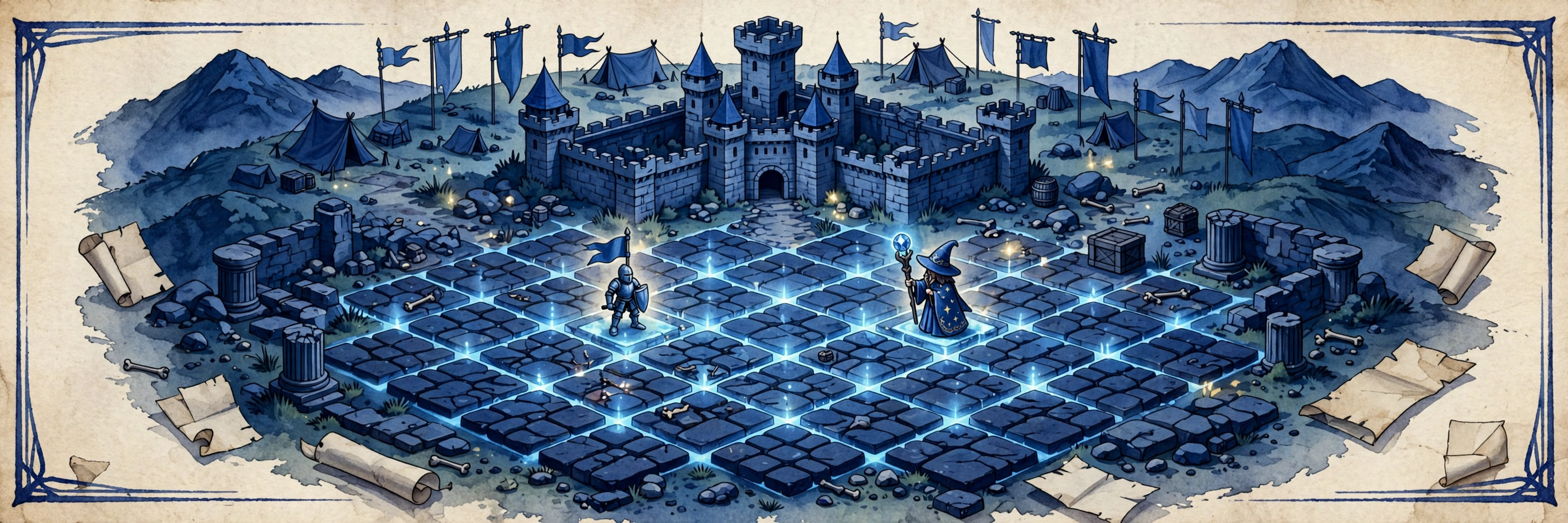
In the same year as Final Fantasy VII (1997), Square released a Final Fantasy built around moving back and forth between travel between locations on a world map and tactical battles on three-dimensional isometric maps — chess-like battlefields, a hero the history books erased, and the deepest job system the series had ever carried. Final Fantasy Tactics is a game you do not so much finish as administer: twenty jobs, five ability slots per unit, and two important numbers displayed on screen — Brave and Faith — quietly deciding a great deal. This guide covers the original Japanese PlayStation version: the complete generic job unlock tree, how Charge Time really orders a battle, and the early-game decisions that shape a whole run.
Quick facts
| Item | Details |
|---|---|
| Original title | ファイナルファンタジータクティクス (Final Fantasy Tactics) |
| Platform | PlayStation |
| Release | Japan: June 20, 1997 / North America: January 28, 1998 |
| Developer / Publisher | Square / Square (Japan) |
| Director | Yasumi Matsuno |
| Music | Hitoshi Sakimoto, Masaharu Iwata |
| Genre | Tactical role-playing |
Overview
Ivalice is a kingdom bled dry by the Fifty Years' War, now sliding into a second conflict — the Lion War — over the royal succession and control of the regency. Two dukes, Larg of the White Lion and Goltana of the Black Lion, raise armies. You follow Ramza Beoulve, a cadet of a famed knightly house, and his commoner friend Delita Hyral, as the war pulls them to opposite sides of the class divide. Behind the dukes stands the Glabados Church and its hunt for the Zodiac Stones — artifacts that turn their bearers into the Lucavi demons. The story is framed as a historian's later account of a suppressed report, and it earns that frame: this is a game about who gets written into history.
Battles play on compact three-dimensional isometric maps of square tiles, with height, facing, terrain and weather all live factors. There is no fixed turn order. Every unit has a CT (Charge Time) counter that rises by its Speed each tick; at CT 100, the unit acts — moving and attacking in either order. Spells and some abilities have their own charge times after being selected, resolving later, on a battlefield that has moved on in the meantime. Every successful action earns both EXP (character level) and JP (Job Points) for the unit's current job. JP buys abilities; accumulated JP raises job level; job level is what unlocks further jobs.
Death is serious. A fallen unit shows a countdown of 3 turns; revive it in time, or it becomes a crystal (or treasure) and is gone permanently — including story characters, once they have truly joined you.
Why it still matters
Tactics was Yasumi Matsuno's first Final Fantasy, built with the team sensibility of Tactics Ogre, and it created Ivalice — a setting the series returned to repeatedly. Its job system took the Final Fantasy V idea (learn abilities in one job, carry them into another) further than any game since: a unit's primary command comes from its current job, but its secondary command, Reaction, Support and Movement slots can hold anything it has ever learned. A Knight who once trained as a Chemist throws potions between sword blows; a Wizard with a Samurai's reflexes parries blades. Builds are authored, not selected.
It is also famously uningratiating: no difficulty settings, story battles in fixed, sometimes brutal configurations, and systems — Zodiac compatibility, Brave, Faith — that the game explains barely or not at all. The depth that makes it replayable for decades is the same depth this guide exists to make visible.
Highlights
- Twenty generic jobs on one unlock tree, rooted in just two starting jobs — Squire for the physical branch, Chemist for the magical.
- Five-slot ability builds. Current job command + one borrowed command + Reaction + Support + Movement, all from a unit's personal history.
- Brave and Faith as underlying physics. Brave affects damage with bare hands, knight swords, katana and similar weapons, and the trigger rate of most Reaction abilities; Faith drives magic power and magic vulnerability — in both directions, for caster and target.
- A story that stays political. Class, church and manufactured history, with the Zodiac Stone horror threaded through a war that would be tragic without any demons at all.
Strategy essentials
1. The complete generic job tree (original PlayStation version)
All twenty generic jobs, with the job levels required to unlock them. JP note: when a unit earns JP, other deployed allies also earn a share of JP in that same job ("spillover"), which is why unlocks arrive faster in a full party than the raw numbers suggest.
| Job | Unlock requirement | Role in one line |
|---|---|---|
| Squire | Starting job (physical root) | Basic attacker; its Support ability JP Boost accelerates everything else |
| Chemist | Starting job (magical root) | Item user who can throw items — the only healer before White Mage |
| Knight | Squire Lv.2 | Armored front line; breaks enemy equipment and stats |
| Archer | Squire Lv.2 | Bow user; charges shots for power — height is its best friend |
| White Mage (Priest) | Chemist Lv.2 | Healing and holy magic; fast casting, fragile body |
| Black Mage (Wizard) | Chemist Lv.2 | Elemental attack magic; the highest magic attack of the basic casters |
| Monk | Knight Lv.3 | Unarmed powerhouse with self-healing (Chakra) and revival (Revive) |
| Thief | Archer Lv.3 | Steals equipment, gil and hearts; high Speed, unlocks the Dragoon path |
| Mystic (Oracle) | White Mage Lv.3 | Status magic — the control branch of the magic tree |
| Time Mage | Black Mage Lv.3 | Haste, Slow, Stop, Quick: controls the CT economy itself |
| Geomancer | Monk Lv.4 | Terrain-based attacks drawn from the tile underfoot; solid all-rounder |
| Dragoon (Lancer) | Thief Lv.4 | Jump leaves the battlefield temporarily, then lands after a delay to strike its target. |
| Orator (Mediator) | Mystic Lv.3 | Talks: recruits humans and monsters, raises/lowers Brave and Faith permanently |
| Summoner | Time Mage Lv.3 | Large-area summon magic at large MP and charge-time costs |
| Samurai | Knight Lv.4, Monk Lv.5, Dragoon Lv.2 | Draws spirit blades from katana (which can break); strong hybrid |
| Ninja | Archer Lv.4, Thief Lv.5, Geomancer Lv.2 | Throws weapons and equips two of them; the fastest physical job |
| Arithmetician (Calculator) | White Mage Lv.5, Black Mage Lv.5, Time Mage Lv.4, Mystic Lv.4 | Casts learned spells for free, instantly, on every unit whose CT/Level/Height/EXP matches a chosen number pattern |
| Dancer | Female unit: Geomancer Lv.5, Dragoon Lv.5 | Repeated dances that debuff all enemies while she keeps dancing |
| Bard | Male unit: Summoner Lv.5, Orator Lv.5 | Repeated songs that buff all allies; Dancer's counterpart |
| Mime | Squire Lv.8, Chemist Lv.8, Geomancer Lv.5, Dragoon Lv.5, Orator Lv.5, Summoner Lv.5 | Copies the previous ally's action with its own strong base stats; the long-term project job |
Names in parentheses are the original North American PlayStation translations. Version caution: in the North American PS release, many ability JP costs were lowered and some job unlock requirements were eased relative to this Japanese original. Do not treat the PSP version as the same kind of eased version as the North American PS release — check PSP figures version by version, as some of its values were returned toward the Japanese original. The later PSP War of the Lions also adds two jobs (Dark Knight, Onion Knight) that do not exist in this version.
2. CT, Speed and charged actions
| Mechanic | How it works | Practical consequence |
|---|---|---|
| CT gain | Each tick, a unit's CT rises by its Speed value; at 100 the unit takes its turn | Speed is the master stat. A faster unit does not hit harder — it simply acts more often, forever |
| Move + Act | A turn is one move and one action, in either order | Attack-then-retreat and advance-then-attack are both standard; plan the order, not just the destination |
| Charged actions | Spells and some abilities resolve after their own charge time, aimed at a tile or a unit | A unit target is followed even to the square the target moves to; a tile (panel) target stays fixed to that location. Choose by predicting enemy movement and whether allies may be caught in the effect |
| Turn preview | The game lets you check the upcoming action order (AT list) | Before committing to a slow spell, confirm who acts before it lands — including the enemy |
| Waiting direction | A unit that waits keeps the facing it is left in | Face toward the direction likely attackers will come from, so you do not expose your back; back attacks are punished hard |
3. Brave, Faith and Zodiac — the numbers under the numbers
| System | Effect | What to do with it |
|---|---|---|
| Brave (0–100) | Affects damage with bare hands, knight swords, katana and similar weapons; most Reaction abilities trigger at a % equal to Brave; very low Brave (under 10 in battle) turns a unit into a chicken that flees | Keep front-liners' Brave high. Orators and story events can raise or lower it permanently (± small steps per success); do not let a joke lower your best unit's Brave for good |
| Faith (0–100) | Scales magic damage and healing dealt and received — caster's Faith × target's Faith drives the result; at very high Faith a unit may leave to become a believer after battle; at 0 Faith, magic simply does not work on the unit | Raise Faith on mages, keep it moderate on units you heal with magic. A 0-Faith/low-Faith front-liner is a wall against enemy mages but cannot be healed by spells |
| Zodiac compatibility | Every unit has a sign. Damage and hit rates shift by the pairing of attacker's and target's signs and genders: best / good / neutral / bad / worst | You cannot plan a whole army around it, but for boss fights, matching your heavy hitter's "best" pairing against the boss's sign is a real, free damage swing. Ramza's sign is chosen by the birthday you set at the start |
| Permadeath counter | A KO'd unit counts down from 3; at 0 it crystallizes and is lost forever (guests and not-yet-joined characters excepted) | A revive (Phoenix Down, Monk's Revive, White Mage's Raise) is almost always worth more than an attack. If you cannot revive in time, winning the battle before the counter ends also saves the unit |
4. Early-game priorities that shape a run
| Priority | Why |
|---|---|
| Teach everyone JP Boost (Squire Support) early | It multiplies JP gain for the entire game; every hour without it is a tax on every unlock in table 1 |
| Keep one Chemist-capable healer at all times | Items never miss and never wait for charge time. Early White Mages die while charging; a Chemist's Potion lands now |
| Do not abandon the base jobs | Mime demands Squire Lv.8 and Chemist Lv.8. Units rotated out of the roots entirely make the endgame tree longer, not shorter |
| Fight story battles slightly over-leveled, side content at level | Enemies in random battles scale with your party level, while story-battle enemies are basically fixed, so levelling affects the two differently: grinding makes random fights heavier, but does not raise story-battle enemies |
| Recruit and keep a spread of signs and genders | Dancer and Bard are gender-locked, and Zodiac pairings reward a varied roster in boss fights |
Who it's for
Players who enjoy building systems more than executing combos: planners, optimizers, and anyone who wants a tactics game whose story is as dense as its mechanics. It rewards patience and record-keeping, and it punishes autopilot — a mid-game castle sequence has ended more runs than any final boss. Players who want the modernized script, extra jobs and cutscenes should choose the PSP remake knowingly; players who want the 1997 balance and text should start here.
How to play it today
The original PlayStation version is available through official re-releases of the classic version on modern storefronts, and original discs circulate on the second-hand market. The PSP remake, The War of the Lions (2007), is a different balance with additional jobs and story scenes — treat guides for it as close cousins, not as documentation of this version.
Find original hardware editions on eBay
As an eBay Partner Network affiliate, Enkeisha may earn a commission from qualifying purchases made through these links.
Search eBay listings (affiliate link)
Check the language, region, hardware compatibility, condition and authenticity before buying. Search results may include reproductions; links do not endorse individual sellers.