Written by George Abe · Illustrated by Masasumi Kakizaki · 22 volumes
RAINBOWNisha Rokubō no Shichinin
What seven boys pass around a locked room
Read the reviewOne last drag
There’s enough of the cigarette left for one more drag. Rokurōta Sakuragi hands it to Mario, the last of six newcomers to Block 2, Cell 6. A few pages earlier they were fighting. Now Sakuragi is making them introduce themselves and telling them to leave some for the next boy. The room is still locked when the light comes through the bars.
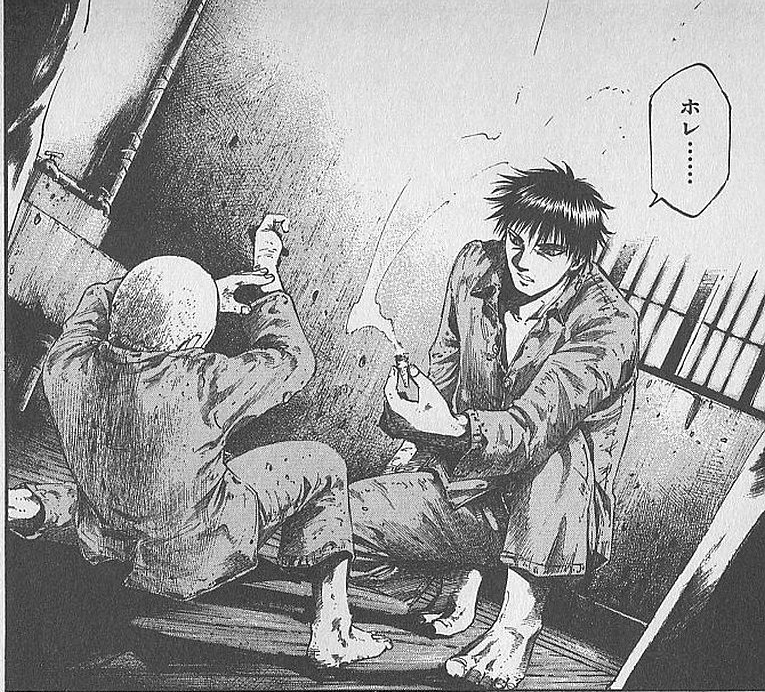
That’s the first favor in RAINBOW that stays with you. George Abe and Masasumi Kakizaki’s 22-volume manga begins at a juvenile training school in 1955, ten years after Japan’s defeat in World War II. Its boys have little reason to trust anyone who has power over them. And yet they let one another have a turn. The pleasure of reading the entire series is seeing how far that small courtesy can travel and who eventually gets to pass it on.
The manga depicts graphic violence and sexual abuse, including abuse of minors.
The first names they give each other
On the rain-soaked bus to the training school, one of the boys retrieves a little girl’s doll. Her mother takes his gesture for theft. The girl thanks him, and a guard strikes him. Once the boys arrive, the institution has files, charges and punishments ready for them. Kakizaki gives the reader an early chance to see how little those records can tell us about the person bending down to pick something up.
Sakuragi, the older boy already in the cell, comes to be called Anchan, a familiar way of saying “big brother.” The other names have the sound of boys sizing each other up and getting used to living together. There’s Mario, who thinks with his fists, Heitai (“Soldier”), the big, hungry Cabbage, the wary Baremoto, the quick-thinking Suppon, and Joe, whose first concern is his little sister Meg. When Joe needs to get back to the orphanage to see her, Suppon gets him closer to the door. Watching the two share a fish-shaped taiyaki cake after their escape, you can feel both the delight of getting away and the miserable shortage of time.
The adoption plot also reveals an important limit to the boys’ brotherhood. Joe is desperate to protect Meg. At a window, Kakizaki holds back the full force of her response until Joe can no longer see it. The reader has to sit with a feeling her brother can’t resolve on her behalf. That same distinction matters later when the grown Meg decides how much of her story she wants others to hear.
The faces on the other side of the ropes
The manga follows its characters well past the cell. Jobs, wages and care for family give them new reasons to disagree and new ways to stay in touch. When Joe sings, his voice can reach people his younger self couldn’t get to in person. When Cabbage wrestles, friends can see him on a television surrounded by strangers. By the time Tokyo’s 1964 Olympic signage appears, Kakizaki can fit the sweep of the rebuilding city into a few panels. The official signs are part of the period setting. It’s the glimpses of private lives in the same streets that give this fictional story its sense of time passing.
Look at how often Kakizaki places somebody on the far side of a set of parallel lines. The barred windows in the first volumes keep boys apart. A boxing ring can put different people on either side of its ropes for an evening and still bring them into the same room. A fight with Kenichi Tsuruda starts with a crowd ready to laugh at Mario. By the time those spectators are shouting for both fighters, the story has made being witnessed feel almost as important as winning.
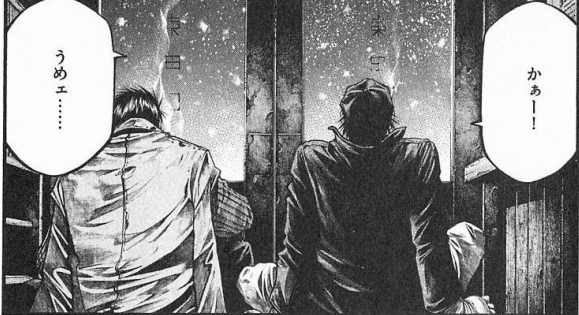
The series sometimes presses the same feeling too hard. Its cruelest men can seem to have little to do besides raise the stakes, and one ordeal can follow another until you start anticipating the next blow. I found the quieter swings more persuasive. In volume 19, Mario and Heitai sit with their backs to us by a hospital entrance, looking out at the snow. Mario asks for a cigarette and remembers the first one. The two of them get a few minutes to sit together before the plot demands anything else.
What it takes to stay
The strongest friendship in RAINBOW can be a roomful of people refusing to let one boy disappear into a cell, or it can be someone at a table asking what another person wants. The series makes room for both through Setsuko and Meg. Setsuko, who was once in a position to help the boys, has friends, a child and commitments of her own. Under enormous pressure, she still has questions to ask and decisions to make. By the later volumes, even the toughest men are starting to understand that someone can care about them and have a say in what happens next.
Read RAINBOW for the brash, bruised faces and the thrill of a close bout. Stay for the way a person you met in a corner of one volume can change the meaning of a scene many books later. Abe and Kakizaki put a great deal of faith in the memory of their readers. They earn it each time they let an ordinary gesture gather weight before it returns.
After the last bell
Open the ending discussion (major spoilers)
The favor that comes back
Sakuragi’s death hurts in part because of how the fifth volume is cut. Mario is winning against Jeffrey while Sakuragi is dying at the base gate. There’s a crowd for one event and scarcely anyone for the other. The story can show us the gap between the two without asking Mario to understand it yet.
Volume 21 goes back to 1953, before any of the six knew him. Tetsu Sakota, a boxer at Sakuragi’s gym, sees a boy in trouble and helps. Sakuragi ends up in the training school after taking the blame for Sakota’s shooting. Sakota fails him in return, spending the money he was supposed to take to Sakuragi’s mother. They keep the idea of facing each other in a professional ring alive through the door of a cell. Years later Joe finds Sakota in the rain and puts an umbrella over him. The way he explains the gesture turns the old favor back toward its source.
Volume 22 also shows what it cost Mario to make it to that ring. Heitai goes into a burning hangar to bring him out. When Meg visits Heitai in detention, she asks him to tell her the next time he thinks he has to take such a risk. She knows the impulse by now. She wants a place in the decision.
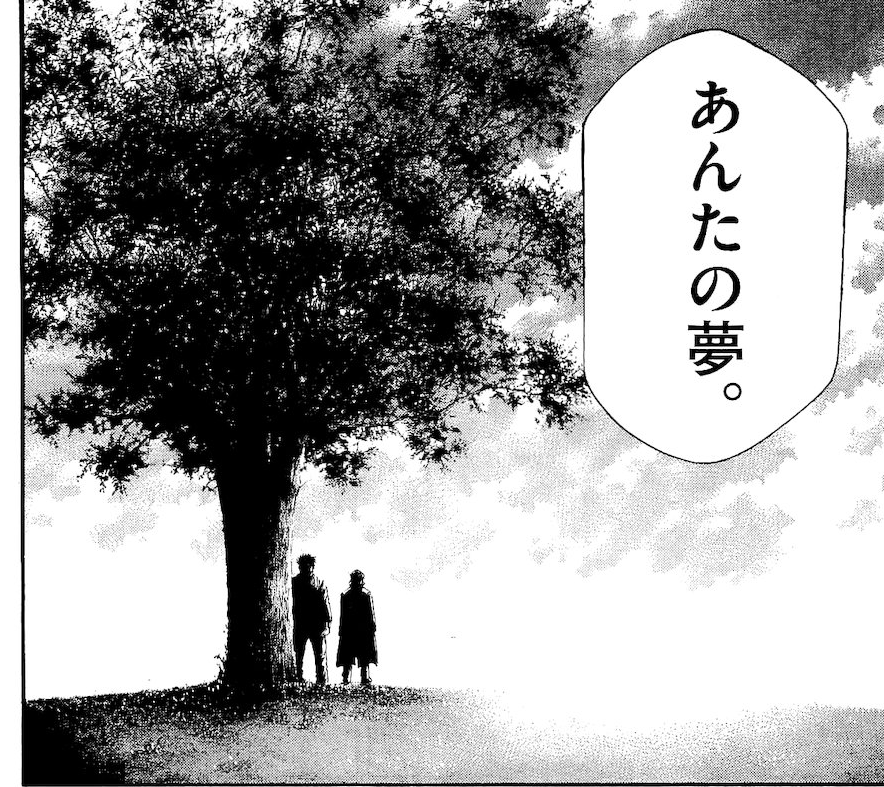
The fight alternates with Mario and Sakota’s earlier conversation beside the tree where the seven carved their dreams. The aftermath supplies the result. Sakota brings the belt to Sakuragi’s grave and finally hands his mother the money. Fulfilling the promise gives Sakota a future he can choose for himself. It also gives Mario, who lost the sight in his left eye and had to leave Japan to get back into a ring, room to imagine a life beyond the promise.
The road in the last chapter
In 1968 a stranger finds Mario at a crossroads in Texas and asks him where he’s going. He has a letter from Lilly with news of his friends. Heitai now works at the same juvenile training school and shakes a boy’s hand as he sends him out. Baremoto is a mainstay at a law office and is still trying to pass the bar exam. Joe has another record. Their lives have room for the workaday business of holding down a job, studying or making music.
Just as Mario might name a destination, the manga cuts back to the rain and lets each boy tell us what he is thinking on arrival. The old pictures look different once we’ve heard those voices. I like that the book ends with room for a detour, a cheeseburger and even a nap. It trusts Mario to go on living after the last page.
Where to start reading
Shogakukan’s Japanese edition is complete in 22 volumes. The first Japanese paperback is ISBN 9784091530318. Manga Cult publishes a German edition, and a Spanish edition has also been published.
An official English edition of the manga did not turn up in the publisher catalogs checked on November 19, 2026.
Enkeisha may earn a commission from qualifying purchases through affiliate links in this section.