A pitch in One Outs can cost far more than a run. Under Toua Tokuchi’s contract, every out earns him five million yen; every run conceded costs him fifty million. His employer has accepted the deal. That does not mean his employer wants him to succeed.
It is an excellent premise for a thriller. The batter wants a hit, the pitcher wants an out, and somewhere above the dugout, a club owner may be hoping for a financial disaster on the mound. A routine pitching change becomes a question of power. A teammate’s mistake can acquire an ugly second meaning.
Yet the contract is only the beginning of what makes Shinobu Kaitani’s manga worth reading across all twenty volumes. Tokuchi enters as a gambler who seems able to turn any encounter into his own game. Around him, a losing baseball team gradually learns to make decisions for itself. The pleasure of watching him outthink everyone remains. What changes is how much the people beside him matter.
The Japanese cover puts Tokuchi’s eyes beside a baseball, under the promise “Nobody wins, but I!” It is an invitation to watch one man dominate. Reading the complete series changes the weight of that boast: you start noticing who else has to stand on the field.
01
A gambler meets a man who has never won enough
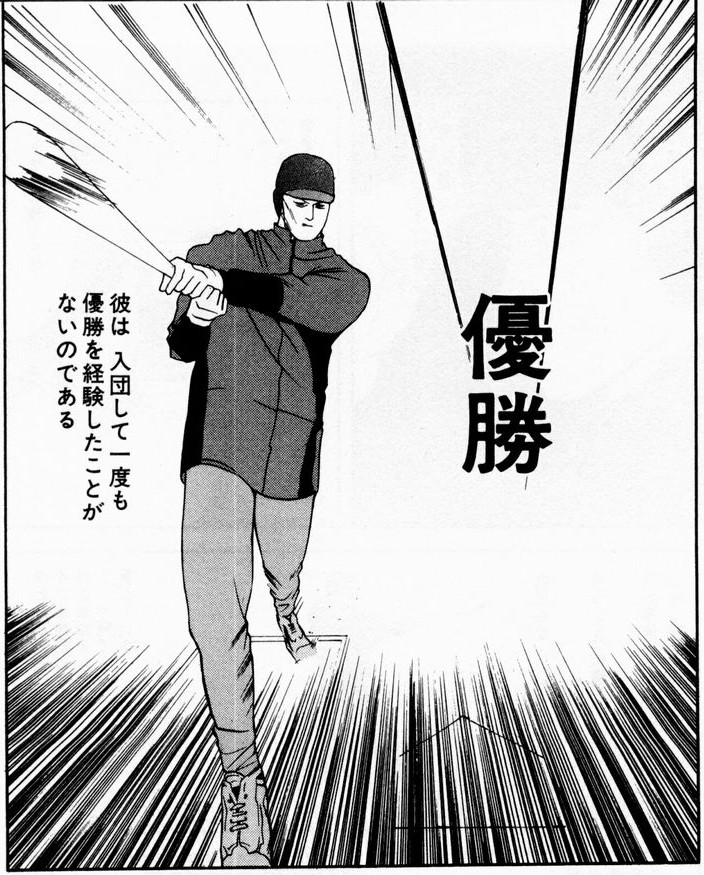
The opening belongs to Hiromichi Kojima, an accomplished veteran batter whose individual success has never brought him a championship. Training in Okinawa, he encounters a form of gambling baseball played between a pitcher and a batter. Its dominant player is Tokuchi, whose unimpressive-looking fastball conceals a much more dangerous understanding of his opponents.
Kojima gives the story something its apparently invincible lead cannot supply on his own: a visible need. He has devoted his life to the sport and still feels that something essential is missing. His encounter with Tokuchi hurts because the manga respects what he has achieved. Experience helps him, but it can also narrow what he expects to happen.
Their confrontations lead Tokuchi into professional baseball with the Lycaons. From there, the five-million-yen-out, fifty-million-yen-run contract turns the scoreboard into a financial battlefield. It is easy to grasp and difficult to stop thinking about. Three outs are worth fifteen million yen. One run can erase that and much more.
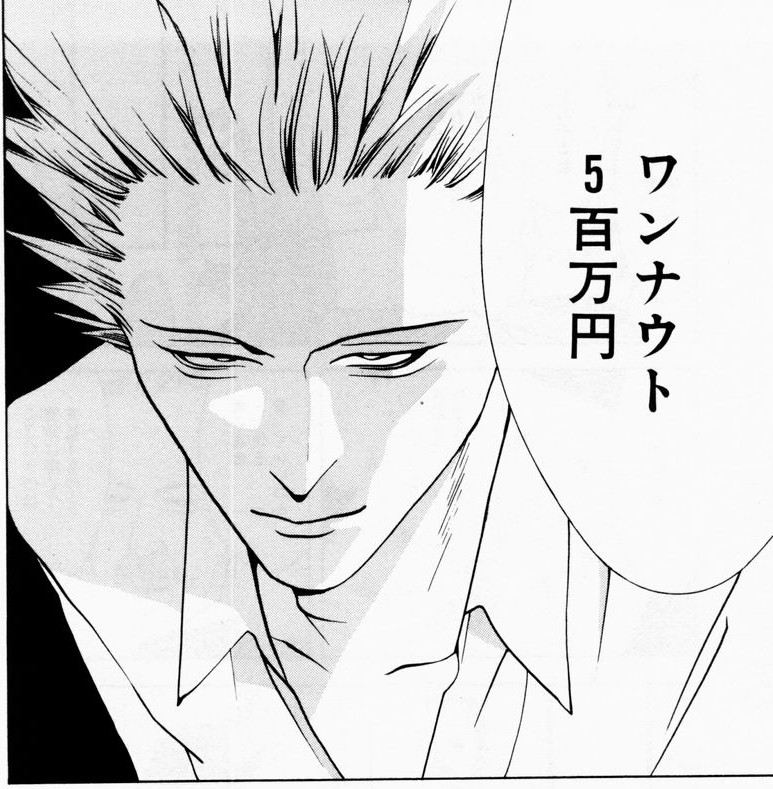
The owner, Saikawa, provides an especially effective source of hostility because he belongs to Tokuchi’s own organization. His interests and the team’s results do not line up. The manga can therefore threaten Tokuchi from several directions without needing every opposing batter to be stronger than the last.
02
Reading an opponent—and changing what they will do
Tokuchi does more than notice a tell or predict a pitch. He influences the information people receive, the risks they fear, and the conclusions they become eager to accept.
A player who hears that he has a tell may start correcting something that was never there. A batter who thinks he has finally understood the pitcher can become easier to guide. Even helpful advice can change a situation in the wrong direction. Tokuchi is dangerous because he treats these reactions as part of the field of play.
This makes the dialogue unusually active. A comment in the dugout, a provocation before an at-bat, or an explanation delivered to the wrong person can matter as much as a throw. When a later reveal changes the meaning of an earlier exchange, a perfectly ordinary baseball ground suddenly looks like a gambling table.
There is a qualification to that pleasure. Kaitani often withholds part of Tokuchi’s process until the explanation arrives. These matches are not consistently fair puzzles in which the reader has every clue needed to solve the trick. They work best when you enjoy discovering how the apparent limits of the contest were manipulated. If you need to reconstruct every solution in advance, some victories will feel too conveniently concealed.
03
Rivals who learn
A mastermind story loses its bite when everyone around the lead has to become foolish. One Outs uses arrogance and misjudgment freely, but its stronger opponents remain capable of observation, practice, and change.
Itsuki Takami is particularly important. He does not simply identify Tokuchi as a genius and wait to lose. He studies what he sees, develops an approach, and revises it when it fails. Junichi Kawanaka brings another mixture: genuine pitching ability, competitive pride, and a personal investment in his own numbers. Neither man exists solely to admire the protagonist.
The changing opposition also keeps the long run from becoming a sequence of identical tricks. The Blue Mars matches place organized deception and illicit methods at the center of the contest. Later, the Mariners become frightening through the accumulation of skill. Equipment, repeated training, and adjustments at the plate begin to reduce advantages that once seemed secure.
Those passages make the later volumes more compelling than a simple escalation of cleverness. Tokuchi’s opponents can improve. Some of them persist after the glamorous solution has failed. His authority over a game consequently becomes something the story can challenge, rather than a guarantee the reader is asked to accept forever.
04
The players beside the genius
Some of the most rewarding material concerns players who initially seem peripheral: Muruwaka, Sugadaira, and Kurai. Their difficulties are not interchangeable. Fear, remembered failure, physical reactions, and an inability to commit to a decision take different forms in different lives.
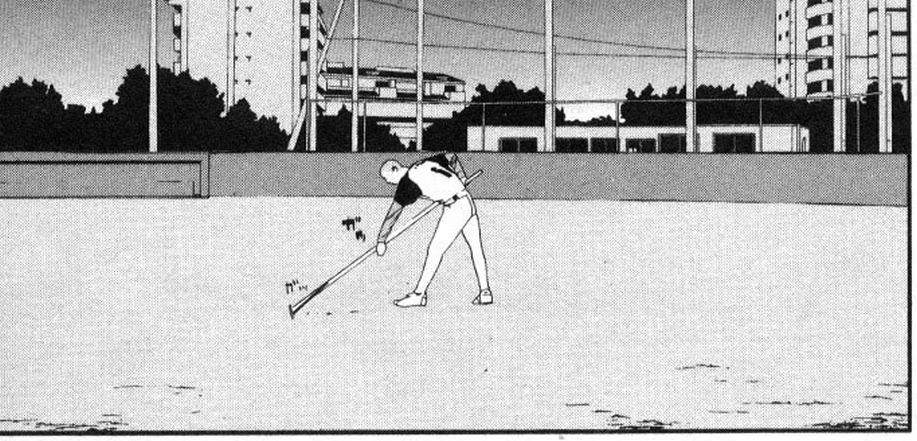
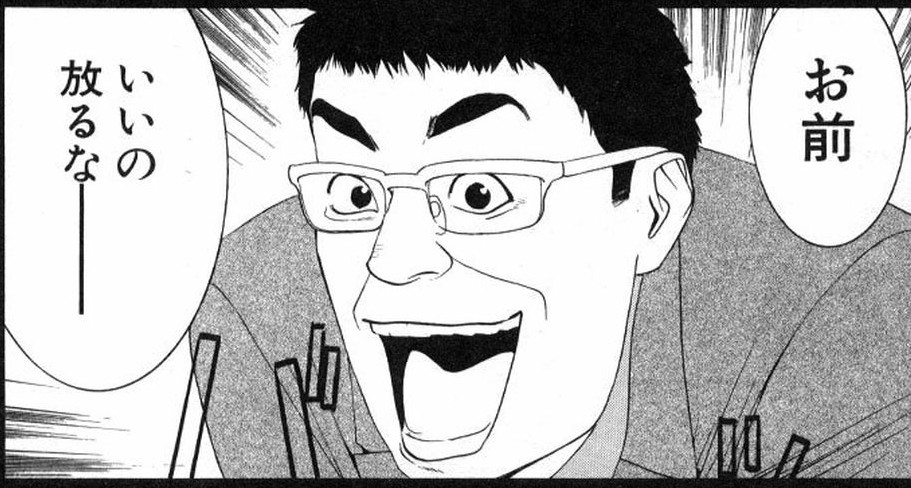
Volume ten gives Kurai an almost empty field to tidy. He has found a way to be useful that leaves little room for actually playing. Then comes the memory of a teacher recognizing something in the boy’s stone throwing. The teacher gets a broad, delighted close-up. After so many faces narrowed by calculation, that uncomplicated encouragement is arresting. Kurai had needed somebody to look at what he could do before a gambler could build a plan around it.
Tokuchi’s responses can be cruel. He provokes, isolates, wagers, and applies pressure. The manga does not become gentle just because it starts caring more about the team. What gives these episodes weight is that the decisive action eventually belongs to the player himself. Tokuchi can alter the circumstances. Someone else still has to swing, run, or throw.
The later changes to ticketing, voting, and player compensation extend this concern from individual psychology to the organization. A striking new incentive does not instantly create a harmonious club. Players become angry, misread responsibility, and look for someone to blame. The consequences have to be worked through in actual games.
Money can divide this team or connect an individual action to a shared win. The difference depends on how the arrangement works and how the players respond. This makes the institutional battles more interesting than a general claim that either money or friendship explains everything.
Gradually, watching film and finding a useful contribution become actions the players initiate. The people around Tokuchi stop looking merely like assistants in his performance. They begin to see opportunities of their own. For me, that is what gives the series its staying power beyond the immediate satisfaction of watching an arrogant opponent panic.
05
The tension before the pitch
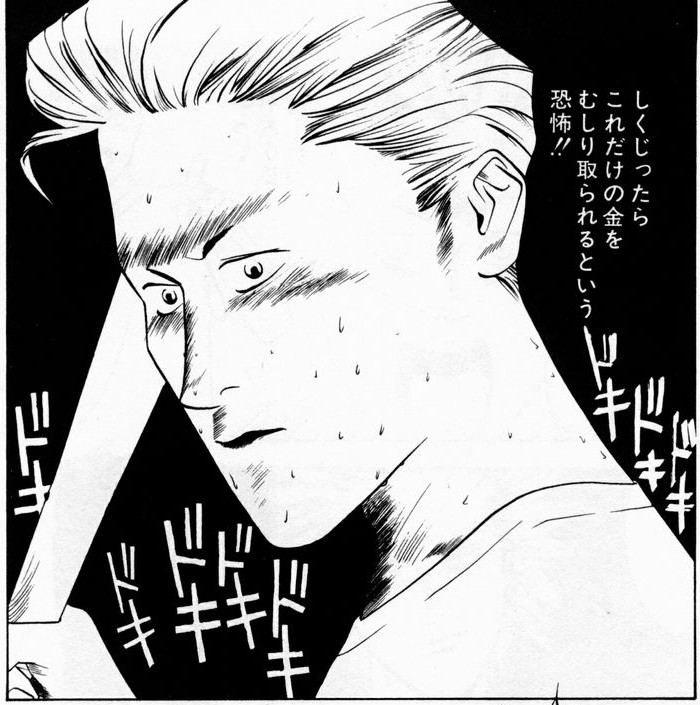
The artwork is especially effective at showing the moment an interpretation changes. A confident mouth tightens. A stare lingers. Someone who thought he understood the situation hears one more sentence and goes still. These reactions help the explanations sustain tension: every new piece of information increases what the next pitch might mean.
Readers primarily seeking fluid athletic spectacle may find the density of talk tiring. The manga is fascinated by the limits of rules and by extreme strategic situations. Its pitching explanations, psychological effects, and institutional maneuvers belong first to this fictional contest; the book should not be treated as a current professional-baseball rulebook or a practical coaching manual.
Basic baseball knowledge helps. Outs, walks, stolen bases, substitutions, and the timing of a game are often the material of the trick. You do not need to be an expert to understand the peril of Tokuchi’s contract, but occasionally checking an unfamiliar term will make a complicated match more satisfying.
06
Why read all twenty volumes?
The main narrative reaches its ending in volume 19. Volume 20 returns to an earlier point for an All-Star story that adds another perspective on what has happened. It is worth reading in publication order: its effect depends partly on what the reader already knows.
That final volume brings public humiliation, professional decline, and the attention surrounding a great achievement into the same game. It lets the manga ask what a player can still choose when he no longer resembles the successful person others expected him to be. Its large-scale trick is entertaining, but its smaller human story is just as valuable.
I would recommend One Outs to readers who enjoy competitive mind games, volatile incentives, and the moment a confident assumption collapses. Its protagonist can be opaque, its solutions theatrical, and its explanations demanding. Across the complete series, however, it becomes more than an exhibition of a clever man winning. You begin by wondering what Tokuchi has planned. You finish caring about what the other players have learned to do.
THE ENDING
What remains after the winning
Read the ending discussion: major spoilers for volumes 17–20
Two defeats with different meanings
The Lycaons’ 14–3 defeat in volume 18 should not be flattened into the same kind of event as their 36–1 defeat in volume 19.
In the earlier game, the Mariners’ work pays off. Tokuchi recognizes that his usual resources are no longer enough and leaves his teammates a way to signal that they want him removed: take off a glove. Nobody does. He finishes the game. The man who ordinarily controls other people has placed something consequential in their hands.
His subsequent recognition that the team has become comfortable for him complicates his intention to leave. I read this as a real tension, not proof that he has secretly become an uncomplicated believer in friendship.
The later, much larger defeat receives a different explanation. Tokuchi has used particular pitches and the hitters’ success against them to distort their baseline swings, preparing the games that follow. The device is extravagant. Its thematic force comes from turning achievement itself into a vulnerability: the Mariners are susceptible because they are skilled enough to trust what has just worked.
A championship beyond the protagonist
Kojima hits the decisive home run in the final league game; Kurai strikes out Takami for the last out. Tokuchi is already absent from the bench when the team wins. This gives the conclusion to the veteran whose need opened the story and to players whose capacity has grown around him.
Kawanaka also changes. Protecting an individual title ceases to be sufficient; he chooses to pitch for his team. Development is not reserved for the eventual winners.
The Lycaons then win the Japan Series without Tokuchi and move toward a citizen-owned future with Kojima as their first manager. Kojima’s later vision of Tokuchi in Okinawa is not an actual reunion. The absence matters. Rather than bringing its genius back to explain everything, the manga leaves the remaining people responsible for what comes next.
What volume 20 adds
The All-Star story centers on catcher Yuichi Nishina, whose diminished performance has made him a target for malicious voting and public ridicule. Blackmail leads him to betray Tokuchi. His circumstances explain the pressure without making his choices harmless.
The ten-consecutive-strikeout challenge produces a characteristic rules-based climax, including a strikeout on which the batter reaches first after an uncaught third strike. Alongside that spectacle, Nishina reaches a less glamorous decision: to reconsider his playing career and prepare to develop other players as a coach. There is more than one kind of result inside this game.
The match also redirects attention toward Tokuchi himself and away from his teammates in advance of the Japan Series. Volume 20 specifies the championship result as four wins to two. The victory without him is therefore both an extension of his planning and an achievement that other players must deliver.
That is the ending’s most interesting tension for me. The series keeps its solitary, abrasive gambler intact, yet makes the outcome depend on a team capable of continuing after he has gone.
07
Start with volume one
Begin in Okinawa, with a professional batter who thinks he understands what a pitch can do. Following what he misses makes the contract—and the silences in the dugout—more interesting when you reach them.
As of November 18, 2026, our research did not identify an official English-language manga edition. The edition and sample linked below are in Japanese. Availability and payment conditions vary by region.
Disclosure: Enkeisha may earn a commission from qualifying purchases through the affiliate links in this section.
This review covers the twenty-volume Japanese series, distinguishing the main story in volume 19 from the All-Star story in volume 20. Two missing images in the volume-one reading material are excluded from the review’s evidence.