MANGA / COMPLETE ONE-SHOT
Kotoba wa Suiteki Mitai ni
A leaking tap, an old argument, and the words left unsaid
Read the review ↓A leaking tap seems a poor explanation for the end of a marriage. Akira Kurokawa gives it the sort of attention usually reserved for a person’s face. By the time this short manga ends, that little fixture has acquired a history neither person can easily put into words.
The setting is a hospital. Dr. Kameda’s patient is Kiyoka, the woman he divorced seven years earlier; she now has another family and needs major surgery. Their conversations keep slipping out of the present and into the habits of a couple who once knew exactly how to annoy each other. The awkwardness can be very funny. It also gives the silences somewhere to hide.
01
A room with two different pasts in it
The opening places a marriage document and a divorce document in succession. On paper, the change is remarkably tidy. The conversations that follow are much less cooperative. A remembered snack or an old form of address can make the years between these people contract, only for a surname to put the distance back.
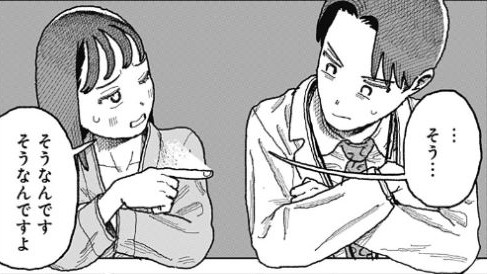
Kurokawa repeatedly lets a face become younger for a moment. Someone jokes; the other person recognizes the joke; then the conversation catches on something that belongs to the present. The reader gets the pleasure of recognizing a shared habit without being allowed to mistake it for a restored relationship. That small hesitation is more persuasive than a speech explaining that the past cannot return.
02
Why the smallest panel has so much work to do
The tap first belongs to an argument about an ordinary domestic irritation. Its close-up briefly removes both people from the picture. We are left with an object that continues doing the same thing regardless of whose explanation sounds more reasonable.
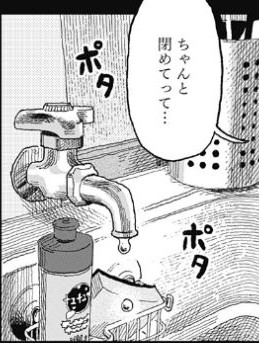
That interruption matters. Facial reactions can push us to take sides quickly; the tap makes us sit through the time after a complaint. Water still falls when the speaker has stopped. The title, roughly Words Are Like Drops of Water, becomes a way of noticing duration before it becomes an idea expressed in dialogue.
The couple’s problem is not an inability to produce words. They can answer, object, tease, and remember. What feels difficult is the much shorter utterance that would require a different account of the speaker’s own behavior. Kurokawa gives that difficulty a place on the page instead of leaving it entirely inside a character’s thoughts.
03
The jokes keep the conversation moving—and stuck
A proposal involving a snack brand is particularly ridiculous. Some of the wordplay travels less easily than the physical comedy: the Japanese names and familiar products carry associations an English reader may not share. The important thing is how much effort Kameda puts into a performance he thinks should be charming, and how quickly Kiyoka recognizes it as his.
The broader comedy occasionally interrupts the sadness more abruptly than I wanted. Readers looking for a consistently subdued relationship drama may feel the same resistance. Yet the jokes also establish a convincing refuge for these two people. They know how to keep a conversation going without letting it arrive at the thing that hurts.
Watch the moments after a grin. A character is still looking at the other person, waiting for an answer. Those little waits give Kiyoka a presence beyond the memory Kameda has brought into the room. She is recognizable to him; she is also living a life he does not get to narrate.
04
A one-sitting story that rewards a second look
The color title page separates its two profiles vertically and turns their attention in different directions. The interior pages keep putting people, tables, and remembered rooms into new relationships. This is a good short manga for a reader who likes to look back at an earlier composition after learning something about the people inside it.
The operation gives the later pages an urgency that the domestic scenes do not have. I found the shifts in scale more effective than the medical spectacle on its own: the story can grow very loud, then leave an everyday action carrying the ending. Its modest length makes that return easy to feel. A room seen a few minutes earlier has become somewhere else.
THE ENDING
After the final page
Read the ending discussion (major spoilers for the complete one-shot)
The family that might have been
Kiyoka’s gratitude reaches Kameda in the present. His apology is associated with an alternative past: the family life that might have followed an earlier change. The softened panels distinguish that possibility from the family photograph we return to. Treating the imagined household as a literal reunion would erase the ending’s most consequential choice.
The successful operation preserves Kiyoka’s future with her existing family. It does not restore Kameda’s former place in it. He can care about what continues without becoming its center. That is a more interesting outcome than making the medical crisis a route back into a relationship.
A small action after an enormous effort
The last image returns Kameda to a sink. He stops the water. The gesture cannot recover the years or confirm what his next relationship will be. It does show a difference in how he occupies a familiar space. After the noise of the operation, the manga trusts a man’s back and a small household action to carry what has changed.
05
Read the Japanese original
Published on Shonen Jump+ on December 11, 2022, this self-contained story is collected in the 2025 Japanese anthology Yomikiri-shū ‘Jō’ (読切集『情』). The review covers this web one-shot, not every story in the anthology. The English rendering of the Japanese title here is descriptive, not a verified official English title.
As of November 18, 2026, our research did not identify an official English edition of this story. The original and collection linked here are in Japanese.
Disclosure: Enkeisha may earn a commission from qualifying purchases through affiliate links in this section.