Learn Japanese · A reader’s guide
Japanese for Travel: Practise the Question You’ll Hear Back
It’s easy to memorise what you want to ask in Japanese. The harder part can be hearing the question that comes back. Practise both sides of two small exchanges before you travel. A picture or a map is enough to get started.
Enkeisha Editorial ·

At the counter: decide where you’ll eat
Imagine a café counter. If you hear omochikaeri desu ka (お持ち帰りですか, ‘Is that to go?’), try either mochikaeri de (持ち帰りで, ‘To go, please’) or koko de tabemasu (ここで食べます, ‘I’ll eat here’). Say the question once, turn away from the text and choose one reply. The exact wording can vary, so listen for mochikaeri.
At the station: ask about one destination
Point to a place on your map and ask kono densha wa Kyoto ni ikimasu ka (この電車は京都に行きますか, ‘Does this train go to Kyoto?’). Have a partner answer hai, ikimasu (はい、行きます) or iie, ikimasen (いいえ、行きません) in random order. Listen for the ending of the verb before you look at their face or the written answer.
Keep one repair phrase ready
When a reply is too fast, try mō ichido onegaishimasu (もう一度お願いします, ‘Once more, please’). Use it during practice instead of stopping the exercise. If you’re studying alone, say it, replay the line and try to answer before checking the text.
Choose a resource for the part that needs practice
Use a picture or map if you need a scene to anchor the words. Use the travel audio pack when the challenge is hearing the reply. Listen at a natural speed, check anything you missed in the slower version, then return to the natural recording. The free picture PDF is a separate resource.
Related books, materials or games
Discover Japan
Japanese Travel Conversations Audio 1 - Natural and Slow
Eight travel dialogues as 16 MP3s at natural and slow speeds, with a five-page guide. A separate audio resource.
Discover Japan
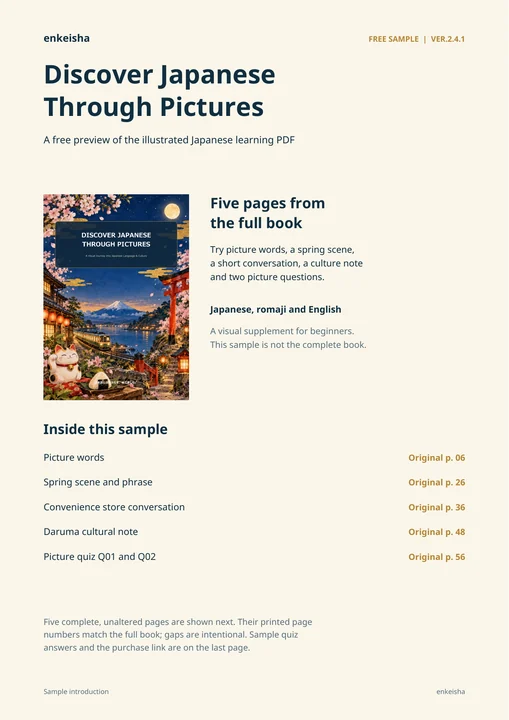
FREE SAMPLE — Discover Japanese Through Pictures (7-page PDF)
Seven pages of illustrated words, a convenience-store conversation, a cultural note, and a short quiz. Japanese, romaji, and English. No audio.